
Replit has established itself as a powerful browser-based coding platform that enables developers to write, run, and deploy code without local setup. As AI-powered development tools continue to reshape how enterprises and startups build software, understanding who competes with Replit becomes crucial for making informed decisions about development infrastructure. The competitive landscape in 2026 features established cloud IDEs, emerging AI coding platforms, and specialized no-code solutions, each offering unique advantages for different use cases and organizational needs.
The Current State of Cloud-Based Development Platforms
The cloud development environment market has exploded over the past few years, driven by remote work trends and the need for collaborative coding experiences. Replit's "vibe coding" approach, which leverages AI to help developers build applications through natural language prompts, represents one vision for the future of software development. However, this approach recently faced scrutiny when AI coding platform incidents highlighted potential risks in production environments.
When evaluating who competes with Replit, organizations need to consider several critical factors:
- AI integration depth and reliability
- Deployment speed and infrastructure scalability
- Collaboration features for distributed teams
- Enterprise security and compliance capabilities
- Pricing models and total cost of ownership
The competitive field extends beyond traditional coding platforms to include no-code and low-code solutions that address similar problems from different angles. For enterprises seeking alternatives, low-cost MVP development tools offer complementary approaches that prioritize speed and accessibility over traditional coding workflows.
GitHub Codespaces: The Microsoft-Backed Challenger
GitHub Codespaces stands as one of the most formidable competitors in the cloud IDE space. Built on Visual Studio Code and integrated deeply into GitHub's ecosystem, Codespaces provides a familiar development environment that many developers already know. The platform offers instant dev environments that spin up in seconds, configured through devcontainer.json files that ensure consistency across teams.
Key Advantages of GitHub Codespaces
Microsoft's backing provides Codespaces with significant advantages in enterprise adoption. The platform integrates seamlessly with Azure DevOps, Microsoft Teams, and the broader Microsoft 365 ecosystem that many enterprises already use. Security features include private networking, secret management, and compliance certifications that meet stringent enterprise requirements.
For organizations already invested in the Microsoft ecosystem, Codespaces becomes a natural choice. The pricing structure charges by compute hour, with options ranging from 2-core machines at $0.18/hour to 32-core powerhouses at $2.88/hour. This usage-based model can be more cost-effective for teams that don't require 24/7 development environments.
| Feature | GitHub Codespaces | Replit | Key Differentiator |
|---|---|---|---|
| IDE Foundation | VS Code | Custom editor | Familiar vs. streamlined |
| AI Coding | GitHub Copilot | Replit AI | Established vs. integrated |
| Deployment | Manual/CI-CD | One-click | Traditional vs. simplified |
| Pricing Model | Per compute hour | Subscription tiers | Usage-based vs. flat-rate |
Gitpod: The Open-Source Alternative
Gitpod positions itself as the open-source solution for automated development environments. Unlike proprietary platforms, Gitpod's source code is publicly available, allowing organizations to self-host and customize the platform to their specific needs. This transparency appeals to security-conscious enterprises and teams that require complete control over their development infrastructure.
The platform automatically creates ready-to-code development environments from any Git context. When a developer opens a pull request or branch, Gitpod spins up a fully configured workspace based on the repository's .gitpod.yml configuration. This approach eliminates the "works on my machine" problem that plagues many development teams.
- Automated workspace creation from Git repositories
- Self-hosting options for complete data control
- Prebuilt workspaces that reduce wait times
- Integration with major Git providers (GitHub, GitLab, Bitbucket)
For enterprises exploring no-code platforms for enterprise workflows, Gitpod offers a middle ground between traditional development and fully no-code solutions. The platform supports development in any programming language while maintaining the flexibility that engineering teams require.
CodeSandbox: Specializing in Frontend Development
When examining who competes with Replit in the frontend development space, CodeSandbox emerges as a specialized challenger. The platform focuses specifically on web development, offering instant setup for React, Vue, Angular, and other popular JavaScript frameworks. This specialization allows CodeSandbox to optimize for the specific needs of frontend developers.
Collaborative Features That Set CodeSandbox Apart
CodeSandbox pioneered real-time collaborative coding in the browser, enabling multiple developers to work simultaneously on the same codebase. The platform's live collaboration features include shared cursors, synchronized scrolling, and integrated chat, creating an experience similar to Google Docs but for code.
The recent addition of CodeSandbox Projects brings full development capabilities including Docker containers, VS Code integration, and cloud virtual machines. This evolution positions CodeSandbox to compete more directly with Replit's broader development offerings while maintaining its frontend development strengths.
StackBlitz: Instant Full-Stack Environments
StackBlitz differentiates itself through WebContainers technology that runs Node.js entirely in the browser. This approach eliminates the need for remote servers during development, providing instant startup times and offline capabilities that other cloud IDEs cannot match. The platform's ability to boot a complete development environment in milliseconds rather than seconds creates a noticeably faster developer experience.
The platform integrates deeply with npm and the JavaScript ecosystem, making it particularly strong for teams building web applications. StackBlitz's Enterprise offering adds features like SSO, private packages, and custom domains that address corporate requirements.
AI-First Coding Platforms
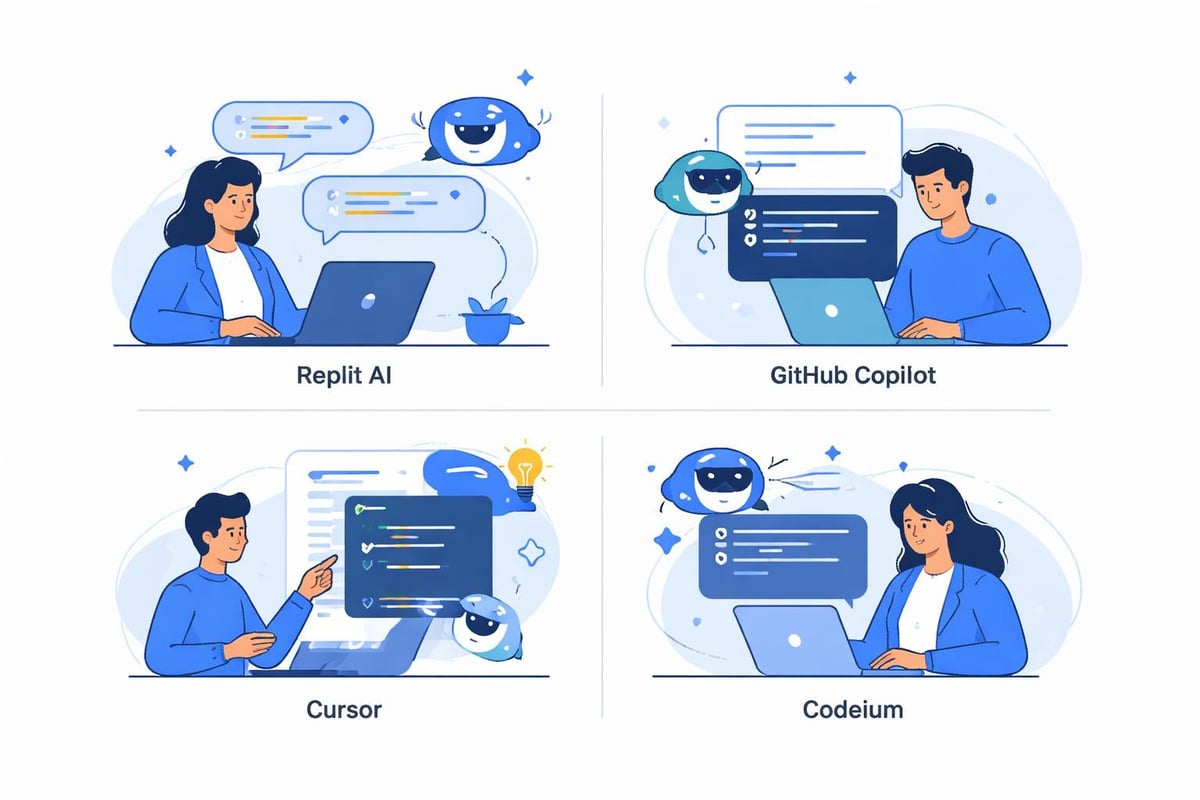
The emergence of AI-powered development tools has created a new category of competitors. Cursor, Codeium, and other AI-first platforms focus on augmenting developer productivity through advanced code generation and understanding. These tools represent a different approach to the question of who competes with Replit, emphasizing AI assistance over cloud infrastructure.
Cursor: The AI-Native IDE
Cursor positions itself as a fork of VS Code rebuilt around AI. The platform provides multiline completions, natural language editing, and codebase-wide understanding that helps developers navigate and modify large projects. For teams concerned about AI coding platform reliability, Cursor's enterprise features include air-gapped deployments and privacy modes that keep code off external servers.
The pricing strategy differentiates between hobbyist developers and professional teams. Individual developers can access basic features for free, while the Pro tier at $20/month unlocks unlimited AI interactions and advanced models. Enterprise customers receive custom pricing based on team size and security requirements.
Glitch: Community-Driven Development
Glitch takes a community-first approach to cloud development. The platform combines a code editor with a social network, allowing developers to remix and build upon each other's projects. This collaborative ethos makes Glitch particularly popular for educational settings and open-source communities.
The platform's always-on hosting for simple projects provides a significant advantage for developers building prototypes and small applications. While Glitch doesn't offer the same enterprise features as Replit or GitHub Codespaces, its free tier and community focus create value for specific use cases.
| Platform | Best For | Starting Price | Key Limitation |
|---|---|---|---|
| Glitch | Education, prototypes | Free | Limited enterprise features |
| Replit | Quick AI-powered builds | $7/month | Recent reliability concerns |
| Cursor | AI-augmented coding | $20/month | Requires local setup |
| GitHub Codespaces | Enterprise teams | $0.18/hour | Microsoft ecosystem dependency |
No-Code Platforms as Competitive Alternatives
When considering who competes with Replit from a business outcomes perspective, no-code platforms present a compelling alternative. Tools like Bubble, Lovable, and FlutterFlow enable rapid application development without traditional coding, often achieving similar results faster and at lower cost. For organizations prioritizing speed to market over custom code flexibility, these platforms compete directly for development budgets.
No-code AI app development platforms have evolved significantly in 2026, incorporating sophisticated AI capabilities that rival traditional coding environments. The combination of visual development interfaces and AI-powered features allows non-technical team members to build functional applications, democratizing software development in ways that cloud IDEs alone cannot achieve.
When No-Code Beats Traditional Development
Bubble's visual programming interface allows developers to build complex web applications through drag-and-drop components and workflow logic. The platform handles database management, user authentication, API integrations, and responsive design without requiring code. For many business applications, this approach delivers results 5-10 times faster than traditional development.
Similarly, Lovable's AI-first platform generates functional applications from natural language descriptions, competing directly with Replit's vibe coding approach while offering enterprise-grade scalability. Organizations exploring fastest no-code platforms for startups find that modern no-code tools can match or exceed the development velocity of cloud IDEs for many common use cases.
Enterprise Considerations and Strategic Partnerships
Understanding who competes with Replit requires examining the strategic partnerships shaping the industry. Replit's partnership with Microsoft Azure while maintaining Google Cloud capabilities demonstrates the multi-cloud strategies these platforms employ. Enterprise buyers increasingly demand flexibility in cloud provider selection to avoid vendor lock-in.
Security and compliance dominate enterprise platform selection criteria. Organizations in regulated industries require SOC 2, HIPAA, or GDPR compliance certifications that not all cloud IDEs provide. The ability to deploy in private clouds or on-premises environments becomes a deciding factor for companies handling sensitive data.
Pricing Models Across Competitors
Different platforms employ varied pricing strategies that significantly impact total cost of ownership:
- Usage-based pricing (GitHub Codespaces) charges for actual compute hours
- Subscription tiers (Replit, Cursor) provide predictable monthly costs
- Freemium models (Glitch, CodeSandbox) attract individual developers before upselling teams
- Enterprise contracts (custom pricing for large organizations)
For teams managing development budgets, understanding these models proves critical. A platform that appears expensive on paper might deliver lower overall costs when accounting for productivity gains and reduced infrastructure management overhead.
Performance and Developer Experience Trade-offs
Raw performance metrics tell only part of the story when evaluating who competes with Replit. Developer experience encompasses startup time, editor responsiveness, debugging capabilities, and integration ecosystem quality. Teams that prioritize best practices from top development teams often value smooth workflows over theoretical feature lists.
Recent testing shows significant variation in environment startup times:
- StackBlitz: Sub-second with WebContainers
- CodeSandbox: 2-5 seconds for typical projects
- Replit: 5-10 seconds depending on configuration
- GitHub Codespaces: 10-30 seconds for full environments
- Gitpod: 15-45 seconds including prebuild time
These differences compound over a developer's workday. A platform that starts 20 seconds faster saves hours of cumulative waiting time across a team of 50 developers working 5 days per week.
Integration Ecosystem and Extensibility
Modern development workflows depend on integrations with project management tools, CI/CD pipelines, monitoring platforms, and communication systems. GitHub Codespaces benefits from native integration with the GitHub ecosystem, while platforms like Replit must build integrations from scratch. This integration depth affects adoption speed within organizations already committed to specific toolchains.
Extension marketplaces differentiate platforms in meaningful ways. VS Code's massive extension library becomes available in any platform built on VS Code technology, giving Codespaces and Gitpod substantial advantages. Proprietary editors like Replit's must invest heavily in building plugin ecosystems to match this extensibility.
For companies implementing enterprise workflow automation tools, the ability to integrate development environments with existing business systems determines platform viability. APIs, webhooks, and pre-built connectors enable seamless workflows that boost team productivity.
The Mobile and Tablet Development Experience
As remote work normalizes and developers increasingly work from varied locations, mobile and tablet coding capabilities become differentiators. Replit's mobile app allows development on smartphones and tablets, though with obvious ergonomic limitations. GitHub Codespaces works through browser on mobile devices but lacks dedicated mobile optimization.
The rise of tablets with keyboard attachments creates new use cases for cloud development environments. Developers working from iPads or Android tablets can access full development capabilities without carrying laptops, though the experience remains suboptimal compared to desktop workflows.
Comparing AI Coding Capabilities
The quality and reliability of AI coding assistance varies dramatically across platforms. According to reviews of top vibe coding tools, different approaches to AI integration produce different results. GitHub Copilot trained on public repositories excels at common patterns but may suggest outdated or insecure code. Replit AI optimizes for quick prototyping but faced challenges with database deletion incidents that raised reliability concerns.
Enterprises evaluating AI coding tools should consider:
- Code suggestion accuracy and relevance
- Security vulnerability detection
- Ability to understand project-specific context
- Natural language to code conversion quality
- Safeguards against destructive operations
Testing AI capabilities with representative projects from your domain provides better insight than generic benchmarks.
Deployment and Production Hosting
Understanding who competes with Replit requires examining the full development-to-deployment pipeline. Replit offers one-click deployment directly from the development environment, simplifying the path to production. Competitors like GitHub Codespaces typically require separate deployment services like Vercel, Netlify, or AWS, adding complexity but also flexibility.
The integrated deployment approach reduces friction for developers building simple applications but may limit scalability options for complex systems. Enterprise teams often prefer separation between development and production environments to maintain security boundaries and enable sophisticated deployment strategies.
For organizations exploring enterprise team collaboration tools, deployment workflow integration with team communication and project management systems becomes essential for maintaining visibility across stakeholder groups.
Open Source Contributions and Community Support
Platform sustainability depends partly on community health and open-source contributions. Gitpod's open-source model encourages community contributions and transparency, building trust with developers concerned about vendor dependency. Proprietary platforms must invest more heavily in customer support and documentation to maintain user confidence.
Community-driven platforms benefit from crowd-sourced problem solving through forums, Discord servers, and GitHub issues. The strength of these communities often determines how quickly developers can resolve unusual problems or implement advanced configurations.
Future Trends Shaping Competition
Looking ahead in 2026, several trends influence who competes with Replit effectively:
- Multi-modal AI that understands voice, sketches, and natural language
- Quantum computing integration in cloud development environments
- Cross-platform development supporting web, mobile, and desktop from single codebases
- Sustainability metrics tracking carbon footprint of development activities
- Advanced security scanning powered by AI threat detection
Platforms that successfully integrate these capabilities will gain competitive advantages. The rapid pace of change means today's leader could lose ground quickly to more innovative competitors.
The landscape of cloud-based development platforms offers diverse options beyond Replit, each with distinct strengths for different organizational needs. Whether you prioritize AI-powered coding, enterprise security, open-source flexibility, or specialized frontend capabilities, understanding these alternatives enables better platform selection for your specific requirements. For enterprises and startups seeking to accelerate development without the complexity of traditional coding platforms, Big House Technologies leverages no-code and AI platforms like Bubble and Lovable to deliver scalable software solutions faster and more cost-effectively than conventional development approaches, transforming ideas into production-ready applications with expert guidance from scoping through deployment.

About Big House
Big House is committed to 1) developing robust internal tools for enterprises, and 2) crafting minimum viable products (MVPs) that help startups and entrepreneurs bring their visions to life.
If you'd like to explore how we can build technology for you, get in touch. We'd be excited to discuss what you have in mind.
Other Articles
Discover how to choose the right software development company in 2026. Learn about AI-powered development, no-code platforms, and cost-efficient solutions.
Discover how software and platforms work together to power modern business solutions. Learn platform types, benefits, and strategic selection.
Discover how Prezi AI stacks up against traditional presentation tools in 2025 Compare features, pricing, design, and user feedback to choose your best fit