
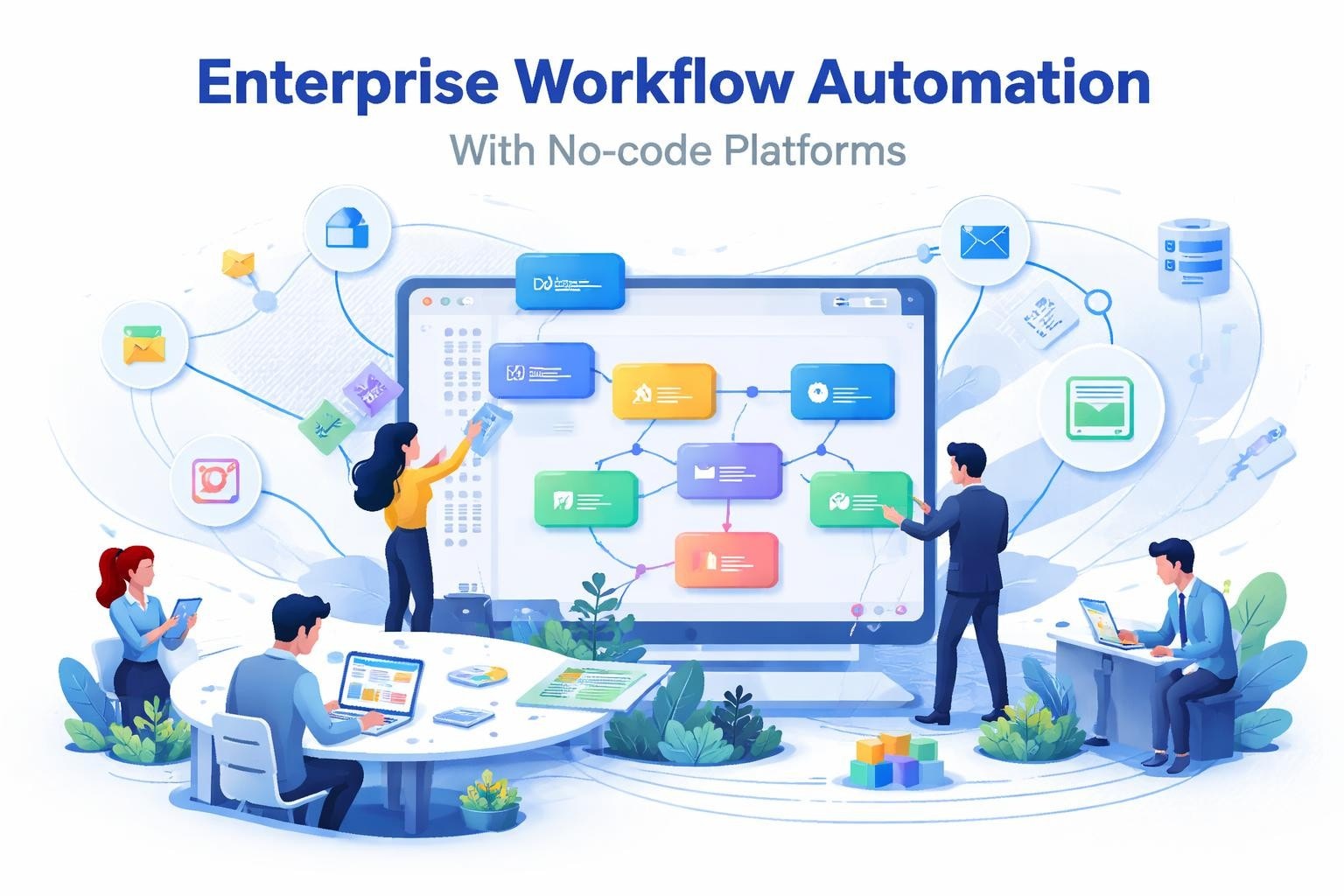
Enterprise organizations are increasingly turning to no-code solutions to accelerate digital transformation while managing complex operational demands. The best no-code platforms for enterprise workflows enable teams to build sophisticated applications, automate processes, and integrate systems without traditional coding. As businesses face mounting pressure to deliver faster results with leaner IT resources, these platforms have evolved from simple form builders to comprehensive development environments capable of handling mission-critical operations. Understanding which platforms offer the right combination of security, scalability, and governance features is essential for enterprise decision-makers in 2026.
Why Enterprises Choose No-Code for Workflow Automation
The shift toward no-code development in enterprise environments stems from several converging factors. Traditional software development cycles often take months or years to deliver solutions, while business needs evolve in weeks. No-code platforms compress this timeline dramatically, enabling business analysts and process owners to create functional applications in days or weeks.
Cost efficiency drives adoption as well. Organizations can redirect expensive developer resources to strategic projects while empowering domain experts to solve their own workflow challenges. The 5 reasons enterprises are turning to no-code for internal tool development include reduced development costs, faster time-to-market, and improved business-IT alignment.
Security and Compliance Considerations
Enterprise-grade no-code platforms prioritize security features that meet regulatory requirements:
- Role-based access control with granular permissions
- SOC 2 Type II compliance and ISO certifications
- Data encryption at rest and in transit
- Audit logging for all system activities
- Single sign-on integration with existing identity providers
These capabilities ensure that workflow automation doesn't compromise organizational security posture. Platforms designed for enterprise use incorporate governance frameworks that maintain control while enabling distributed development.
Top No-Code Platforms for Enterprise Workflow Management
Several platforms have emerged as leaders in the enterprise no-code space, each offering distinct advantages for workflow automation. Understanding their unique strengths helps organizations select the right tool for specific use cases.
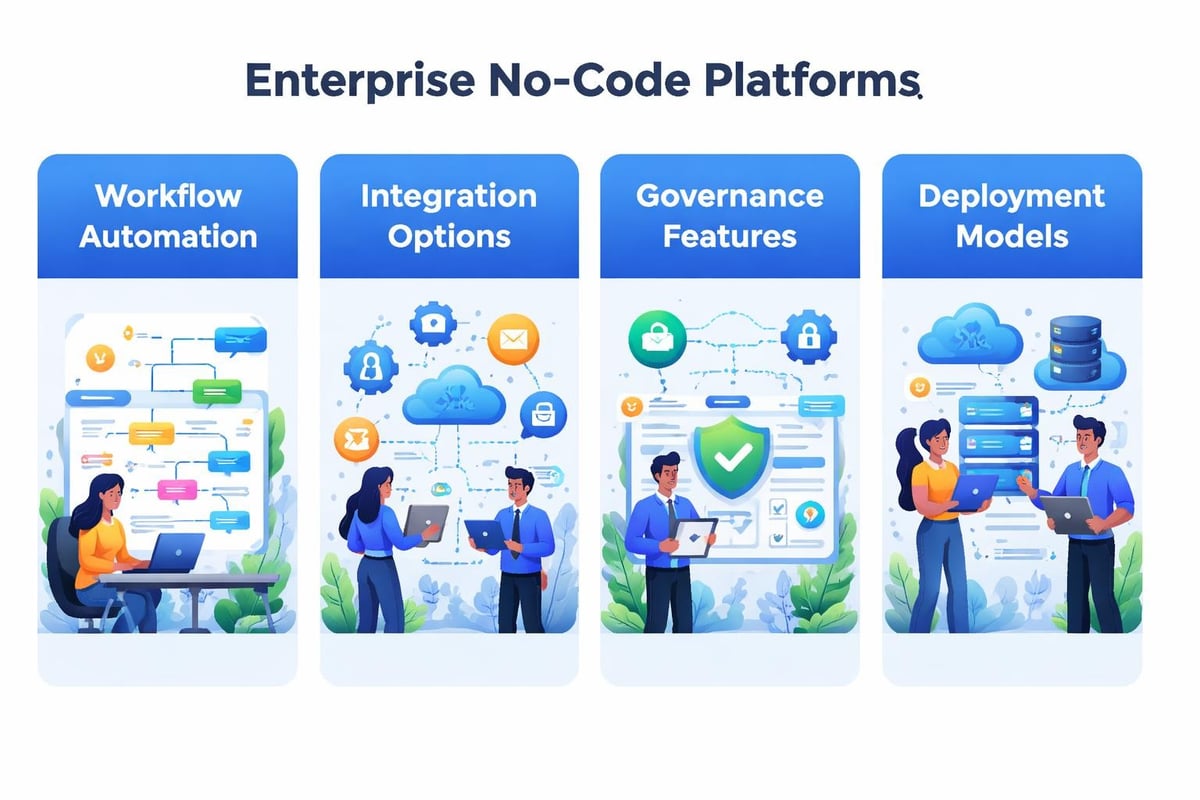
Kissflow: Process-Centric Workflow Automation
Kissflow has established itself as a comprehensive solution for process management and workflow automation. The platform's visual process designer enables business users to map complex workflows without technical expertise. Pre-built templates accelerate deployment for common enterprise processes like procurement approval, employee onboarding, and expense management.
The platform excels in scenarios requiring structured approval chains and document routing. Integration capabilities connect Kissflow to existing enterprise systems through REST APIs and pre-built connectors. For organizations seeking no-code tools for SaaS founders, Kissflow's scalability supports growing operational complexity.
Mendix: Low-Code Platform for Complex Applications
Mendix bridges the gap between no-code simplicity and traditional development power. This cloud-based platform enables visual application development while allowing developers to extend functionality with custom code when needed. Multi-channel deployment supports web, mobile, and progressive web applications from a single codebase.
| Feature | Capability | Enterprise Benefit |
|---|---|---|
| Visual Development | Drag-and-drop interface builder | Faster application creation |
| Data Modeling | Entity relationship diagrams | Complex data structure support |
| Microservices | API-first architecture | Integration flexibility |
| DevOps Tools | Built-in CI/CD pipeline | Automated deployment workflows |
Mendix particularly shines in scenarios requiring sophisticated data models and complex business logic. The platform's model-driven development approach maintains application quality while accelerating delivery timelines.
Zapier: Integration-Focused Automation
Zapier's low-code platform specializes in connecting disparate applications and automating cross-system workflows. With over 5,000 app integrations, Zapier enables enterprises to orchestrate processes spanning multiple software tools without custom integration work. The platform's strength lies in trigger-based automation that responds to events across connected systems.
Common enterprise use cases include:
- Synchronizing customer data between CRM and marketing automation platforms
- Routing support tickets from communication tools to helpdesk systems
- Aggregating metrics from multiple sources into reporting dashboards
- Automating invoice processing across accounting and procurement systems
While Zapier handles many workflow automation needs, organizations with highly specialized requirements may need platforms offering deeper customization. Enterprise integration platforms provide additional context for choosing between integration-focused and development-focused no-code tools.
AppSheet: Google-Powered Mobile Workflows
AppSheet, now part of Google Cloud, transforms spreadsheets and databases into mobile-friendly applications. This approach resonates with enterprises already invested in Google Workspace or organizations seeking rapid prototyping capabilities. Data source flexibility allows connections to Google Sheets, Excel, SQL databases, and cloud storage platforms.
The platform automatically generates user interfaces based on data structure, dramatically reducing development time for data-centric workflows. Field teams benefit from offline-capable mobile applications that sync when connectivity returns. AppSheet's integration with Google's AI capabilities enables intelligent features like optical character recognition and predictive analytics within workflow applications.
Advanced No-Code Platforms for Specialized Enterprise Needs
Beyond general-purpose platforms, specialized solutions address specific enterprise workflow challenges. These tools offer deeper functionality in targeted domains while maintaining no-code accessibility.
Creatio: CRM-Integrated Process Automation
Creatio CRM combines customer relationship management with comprehensive workflow automation. This unified approach eliminates data silos between customer-facing processes and operational workflows. Process-driven CRM functionality ensures sales, marketing, and service teams follow consistent procedures while maintaining flexibility for exceptions.
The platform's business process management engine supports both simple linear workflows and complex case management scenarios. Visual designers enable business analysts to model intricate approval hierarchies and conditional routing logic. For enterprises prioritizing customer experience alongside operational efficiency, Creatio's integrated approach delivers significant advantages.
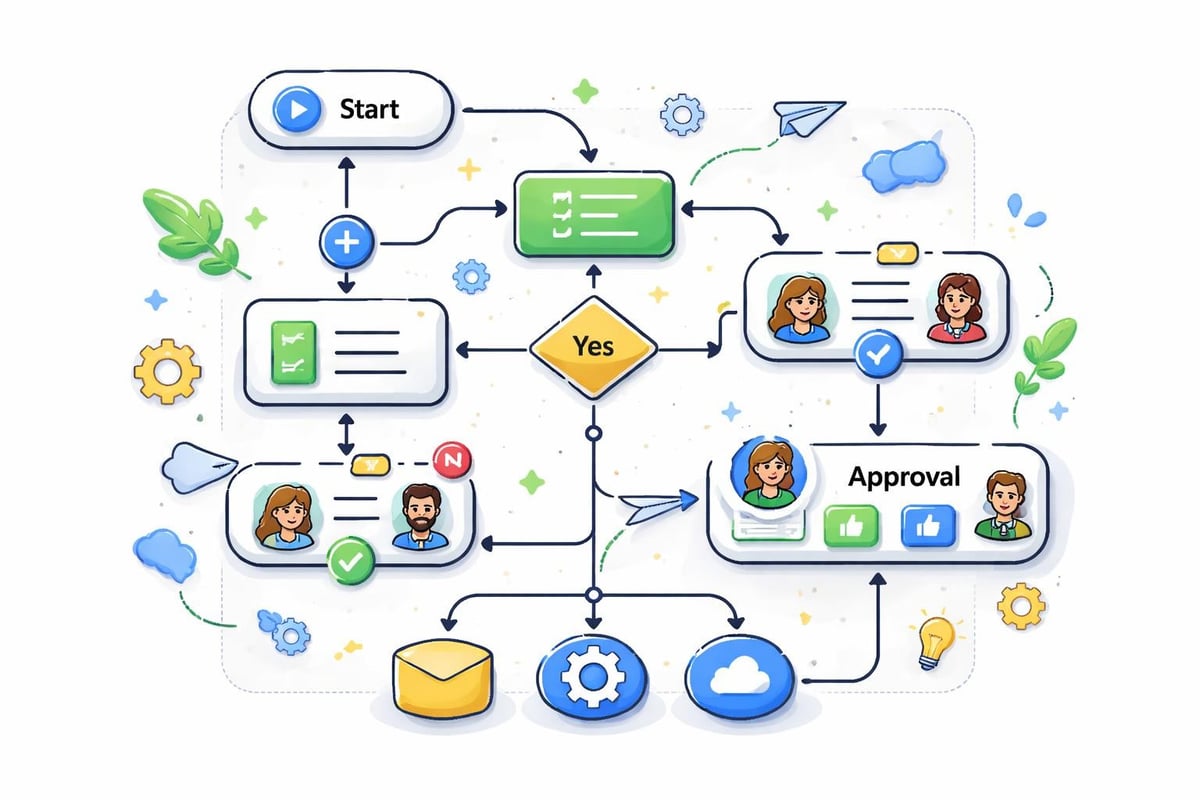
Unqork: Code-Free Enterprise Application Platform
Unqork positions itself as a pure no-code platform eliminating all traditional coding from application development. This radical approach appeals to enterprises seeking to reduce technical debt and dependency on scarce developer resources. The platform's visual application assembly environment enables rapid construction of complex forms, workflows, and business logic.
Financial services and insurance companies have particularly embraced Unqork for regulatory compliance applications and customer onboarding workflows. The platform's audit trail capabilities and version control features support regulatory requirements while enabling continuous improvement of business processes.
OutSystems: Enterprise-Scale Low-Code Development
For organizations requiring the best no-code platforms for enterprise workflows with maximum scalability, OutSystems delivers production-grade application development capabilities. The platform combines visual development with AI-powered coding tools that accelerate complex application creation. Full-stack development support spans from database design through user interface creation and deployment automation.
OutSystems targets scenarios where traditional no-code platforms hit limitations:
- Applications serving thousands of concurrent users
- Systems requiring complex integrations with legacy infrastructure
- Workflows spanning multiple departments and data sources
- Solutions needing advanced security controls and compliance features
The platform's governance framework enables centralized oversight while allowing distributed development teams to work independently. Application lifecycle management tools support enterprise change control processes and testing requirements.
Evaluating No-Code Platforms for Your Enterprise Workflows
Selecting appropriate platforms requires systematic evaluation against organizational requirements. Different workflows demand different platform capabilities, and the best no-code platforms for enterprise workflows often involve multiple tools working together.
Technical Requirements Assessment
| Evaluation Criteria | Considerations | Impact on Platform Selection |
|---|---|---|
| User Volume | Concurrent users and total licenses | Scalability and pricing model |
| Data Complexity | Relationships, volumes, and types | Database capabilities needed |
| Integration Needs | Existing systems and APIs | Connector availability |
| Mobile Requirements | Field access and offline functionality | Native mobile support |
| Customization Depth | Unique business logic complexity | Low-code vs. pure no-code |
Performance requirements significantly influence platform selection. Workflow applications processing high transaction volumes need robust scaling capabilities and optimized data handling. Understanding whether your application development platforms need to support real-time processing versus batch operations helps narrow suitable options.
Governance and Control Features
Enterprise deployments demand governance capabilities that maintain standards across distributed development efforts. Center of excellence models benefit from platforms offering:
- Reusable component libraries that ensure consistency
- Template repositories accelerating new project initiation
- Code review workflows for quality assurance
- Performance monitoring and analytics dashboards
- Access controls preventing unauthorized modifications
Organizations working with development partners like Creator Concepts for MVP development should ensure platforms support collaborative development with external teams while maintaining security boundaries.
Implementation Strategies for Enterprise No-Code Adoption
Successful deployment of the best no-code platforms for enterprise workflows extends beyond technology selection. Organizations must address cultural, procedural, and structural factors that influence adoption success.
Pilot Project Selection
Initial implementations should target workflows offering quick wins while demonstrating platform capabilities. Ideal pilot projects share common characteristics:
- Well-defined business processes with clear success metrics
- Engaged stakeholders willing to provide feedback
- Moderate complexity showcasing platform strengths
- Measurable impact on productivity or cost
- Minimal dependencies on legacy system modifications
Starting with focused use cases builds organizational confidence and develops internal expertise before tackling more ambitious workflow automation initiatives. Teams can explore best tools for building internal dashboards as accessible entry points for no-code adoption.
Training and Enablement Programs
Platform success depends on effective knowledge transfer to business users who will build and maintain workflow applications. Structured enablement programs should include:
- Role-based training paths for different user types
- Hands-on workshops with real business scenarios
- Reference implementations demonstrating best practices
- Ongoing support channels for questions and troubleshooting
- Regular updates on new platform features and capabilities
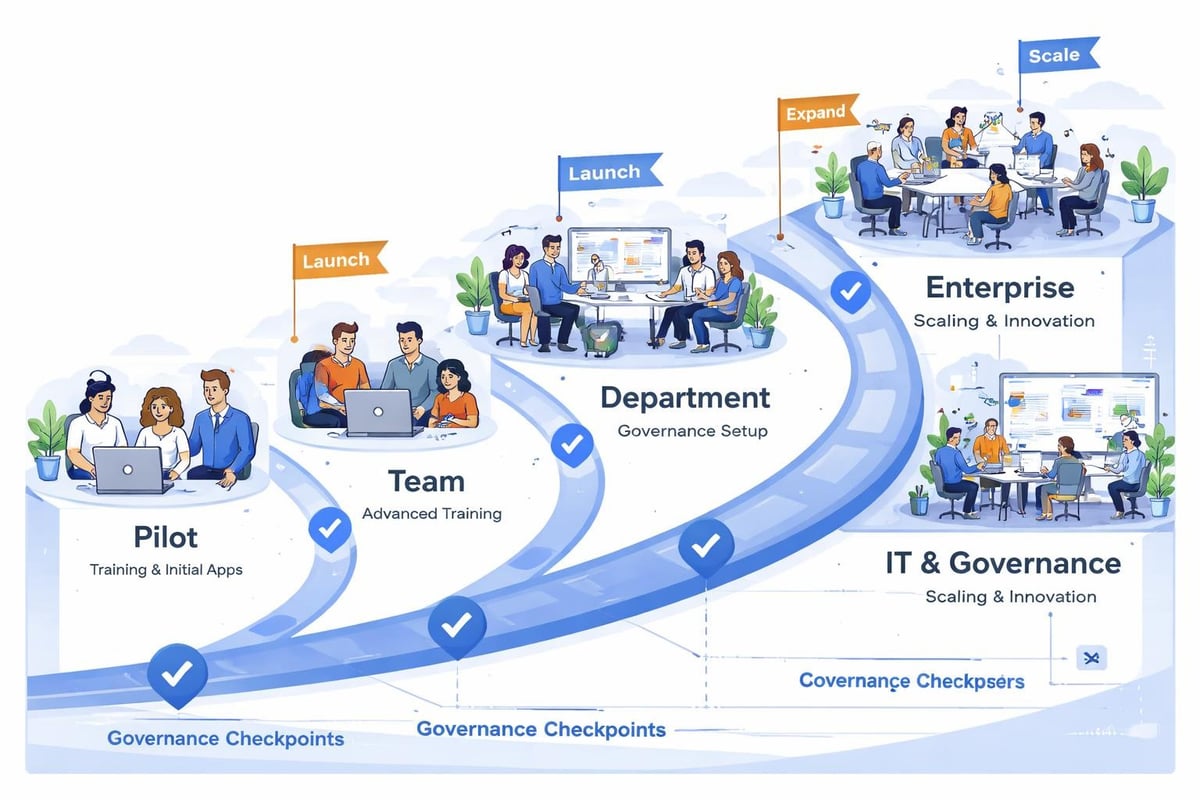
Establishing internal champions who master platforms and support colleagues accelerates adoption across departments. These power users become force multipliers, enabling broader workflow automation without proportional increases in training investment.
Emerging Trends in Enterprise No-Code Platforms
The no-code landscape continues evolving rapidly, with several trends reshaping how enterprises approach workflow automation. Staying informed about these developments helps organizations make future-proof platform selections.
AI-Enhanced Workflow Automation
Artificial intelligence integration transforms no-code platforms from passive builders to active development assistants. AutoGen Studio exemplifies how no-code tools now support multi-agent systems for complex workflows. Natural language processing enables users to describe desired workflows in plain English, with AI generating initial implementations for refinement.
Predictive analytics embedded in workflow applications provide intelligent recommendations and automate decision-making. Machine learning models trained on historical workflow data identify optimization opportunities and suggest process improvements.
Natural Language Workflow Design
Platforms increasingly support natural language input combined with visual workflows, lowering barriers for non-technical users. Instead of learning proprietary visual languages, users describe processes conversationally, with platforms translating descriptions into structured workflows. This approach dramatically reduces training requirements while maintaining the precision of visual development.
Hybrid No-Code/Low-Code Architectures
The distinction between no-code and low-code platforms continues blurring as vendors recognize diverse user needs. Modern platforms offer progressive complexity, presenting simple interfaces to citizen developers while exposing advanced capabilities to technical users. This flexibility ensures platforms can grow with organizational sophistication rather than requiring replacement when requirements exceed initial capabilities.
Platform Integration and Ecosystem Considerations
Workflow automation rarely exists in isolation. The best no-code platforms for enterprise workflows must integrate seamlessly with existing technology ecosystems while supporting future additions to the application portfolio.
API-First Architecture Benefits
Platforms built on API-first principles ensure flexibility in connecting workflow applications to other systems. RESTful APIs enable bidirectional data exchange, allowing no-code applications to both consume and provide services to other enterprise systems. GraphQL support provides efficient data querying for complex integration scenarios.
Webhook capabilities enable event-driven architectures where workflow applications respond in real-time to changes in connected systems. This responsiveness eliminates polling overhead and enables truly automated business processes spanning multiple platforms.
Marketplace Extensions and Add-Ons
Robust ecosystem marketplaces extend platform capabilities without custom development. Pre-built connectors, templates, and components accelerate implementation while reducing costs. Evaluating marketplace maturity and third-party developer engagement provides insight into platform longevity and community support.
Organizations should verify that critical integrations exist as marketplace offerings or can be developed using platform extension frameworks. The availability of industry-specific templates indicates platform suitability for particular vertical markets or use cases.
Cost Considerations for Enterprise No-Code Platforms
Understanding total cost of ownership helps organizations budget appropriately and select platforms offering optimal value. Pricing models vary significantly across no-code platforms, with different implications for enterprise deployments.
Pricing Model Comparison
| Pricing Approach | Structure | Best For | Considerations |
|---|---|---|---|
| Per-User Licensing | Monthly or annual per active user | Predictable user counts | Scales linearly with growth |
| Capacity-Based | Based on data, workflows, or transactions | Variable usage patterns | Requires usage forecasting |
| Platform Licensing | Flat fee for unlimited users | Large deployments | Higher upfront commitment |
| Hybrid Models | Combination of base and usage fees | Complex organizations | Balances predictability and flexibility |
Beyond licensing costs, enterprises should account for implementation services, training programs, and ongoing support. Platforms requiring extensive customization or complex integrations may incur significant professional services expenses that dwarf licensing fees.
Security and Compliance in Enterprise No-Code Platforms
Workflow applications often process sensitive business data and must maintain rigorous security standards. Evaluating platform security capabilities ensures compliance with regulatory requirements and corporate policies.
Data Residency and Sovereignty
Global enterprises must navigate data protection regulations varying by jurisdiction. Geographic data storage controls ensure compliance with regulations like GDPR, which mandate keeping certain data within specific regions. Platforms offering multi-region deployment options provide flexibility to meet diverse regulatory requirements.
Understanding whether platforms operate as data processors or data controllers clarifies responsibility for compliance and breach notification. Clear data processing agreements establish accountability and define security obligations.
Penetration Testing and Vulnerability Management
Enterprise-grade platforms maintain robust security through regular testing and rapid vulnerability remediation. Organizations should verify that vendors conduct frequent penetration testing and participate in responsible disclosure programs. Bug bounty programs indicate commitment to security by engaging external security researchers.
Transparency about security incidents and patch management processes builds confidence in platform security posture. Platforms publishing security advisories and maintaining clear communication channels for security concerns demonstrate maturity in handling security responsibilities.
Selecting the best no-code platforms for enterprise workflows requires balancing technical capabilities, organizational readiness, and strategic objectives. The platforms outlined here represent proven solutions deployed across diverse industries and use cases, each offering distinct advantages for specific workflow automation scenarios. When you're ready to transform your enterprise workflows with scalable no-code solutions, Big House Technologies brings deep expertise in Bubble and Lovable platforms to deliver comprehensive implementations from initial scoping through testing and deployment, ensuring your workflow automation initiatives succeed on time and within budget.

About Big House
Big House is committed to 1) developing robust internal tools for enterprises, and 2) crafting minimum viable products (MVPs) that help startups and entrepreneurs bring their visions to life.
If you'd like to explore how we can build technology for you, get in touch. We'd be excited to discuss what you have in mind.
Other Articles
Discover software development for startups in 2025 with a step-by-step guide on strategy, tech choices, and cost-saving tips to accelerate your product’s success.
Discover 9 essential apps like Chat GPT to try in 2025 Compare features pricing and benefits to find the best AI chatbot for productivity creativity and research
Discover the best artificial intelligence app picks for 2025 Explore top AI apps transforming productivity creativity and business with key features and expert tips