

Understanding the no-code developer hourly rate landscape is essential for businesses planning to build software solutions without traditional coding. As the no-code movement continues to reshape how enterprises and startups approach development, pricing structures have evolved to reflect the sophisticated skills these specialists bring to the table. In 2026, organizations ranging from Fortune 500 companies to early-stage ventures are investing in no-code talent to accelerate their digital transformation while maintaining budget predictability. The hourly rates for these developers vary significantly based on experience, platform expertise, project complexity, and geographic location, making it crucial to understand what you're paying for and how to maximize your investment.
Current Market Rates for No-Code Developers
The no-code developer hourly rate spectrum in 2026 spans a wide range, reflecting the diverse skill levels and specializations within this growing field. According to recent market analysis, no-code developers typically charge between $75 and $200 per hour, with experience being the primary differentiator.
A comprehensive LinkedIn analysis of 500 no-code developer profiles revealed that the median hourly rate sits at $50, with a mean of $61.4. Most professionals cluster in the $30 to $70 range, though this varies considerably based on platform specialization and project requirements.
Rate Breakdown by Experience Level
| Experience Level | Hourly Rate Range | Typical Capabilities |
|---|---|---|
| Junior (0-2 years) | $30-$50 | Basic app building, simple workflows |
| Mid-Level (2-4 years) | $50-$100 | Complex integrations, database design |
| Senior (4+ years) | $100-$200+ | Enterprise solutions, architecture |
Entry-level no-code developers who are just beginning their journey typically handle straightforward projects with minimal complexity. These professionals might build basic applications using templates and established patterns, making them suitable for simple internal tools or proof-of-concept projects.
Mid-level developers command higher rates because they bring experience with multiple platforms, understand API integrations, and can design scalable database structures. Their expertise allows them to tackle more sophisticated business requirements while maintaining best practices.
Senior no-code developers justify premium rates through their ability to architect enterprise-grade solutions, optimize performance, and integrate complex business logic. These experts often serve as technical advisors, helping organizations choose the right platforms and development approaches for their specific needs.

Platform-Specific Rate Variations
Different no-code platforms command different pricing structures based on their complexity and market demand. Bubble developers, for instance, represent one of the most sought-after specializations in the no-code space.
Bubble Developer Pricing
Bubble developers charge varying rates depending on task complexity, with simple tasks starting at $10-$30 per hour for basic modifications. However, complex enterprise projects involving sophisticated workflows, extensive API integrations, and custom plugin development can command rates of $75-$120 or more per hour.
The variance in Bubble developer rates reflects the platform's dual nature. While beginners can create functional applications relatively quickly, building truly scalable, production-ready systems requires deep platform knowledge and extensive experience. When evaluating agencies building Bubble MVPs, consider both the hourly rate and the developer's portfolio of completed projects.
Platform specialization matters significantly because each no-code tool has unique capabilities, limitations, and best practices. A developer who excels in Bubble may not be equally proficient in other platforms, making platform-specific expertise a valuable commodity.
- Bubble specialists: $50-$150/hour
- Webflow experts: $60-$140/hour
- Airtable consultants: $40-$100/hour
- Zapier automation experts: $35-$90/hour
- AI platform developers: $80-$200/hour
Geographic and Market Influences
Location continues to play a role in determining the no-code developer hourly rate, though remote work has somewhat equalized pricing across regions. North American and Western European developers typically charge premium rates compared to their counterparts in Eastern Europe, Asia, or Latin America.
However, the gap has narrowed considerably as businesses recognize that no-code development is less dependent on communication nuances than traditional software development. The visual nature of no-code platforms and standardized workflows make remote collaboration more straightforward.
Regional Rate Comparison
North America: Developers in the United States and Canada generally charge $80-$200 per hour, reflecting higher living costs and strong market demand. Major tech hubs like San Francisco, New York, and Toronto see rates at the upper end of this spectrum.
Western Europe: UK, German, and French developers typically charge €60-€150 per hour, with London-based specialists commanding premium rates similar to their North American counterparts.
Eastern Europe: Countries like Poland, Ukraine, and Romania offer competitive rates of $40-$90 per hour while maintaining high quality standards and excellent communication skills.
Asia and Latin America: These regions provide budget-friendly options at $25-$70 per hour, though time zone differences and occasional communication challenges may require consideration.
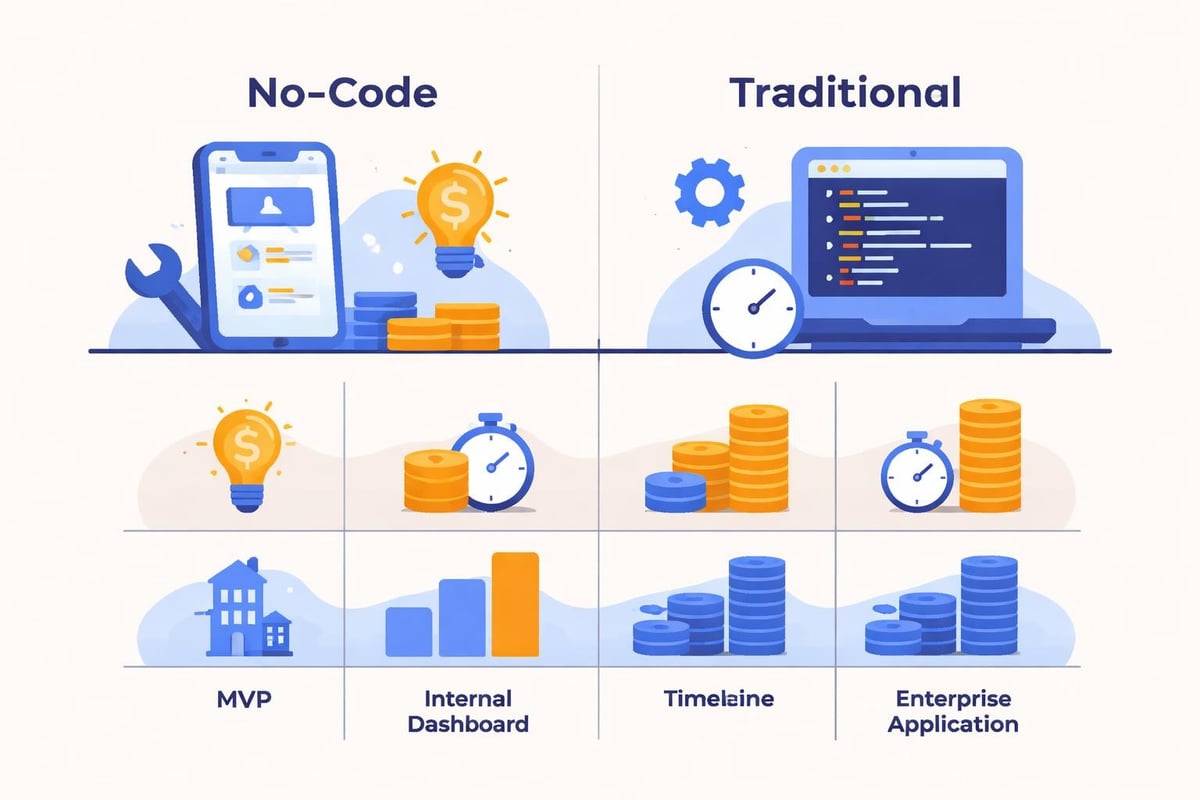
When comparing these rates to traditional software development costs, the expense of hiring various developer types shows that no-code specialists often provide better value for specific use cases, particularly for rapid prototyping and business application development.
Project Complexity and Scope Impact
The no-code developer hourly rate you ultimately pay depends heavily on what you're building. Simple projects with straightforward requirements naturally cost less than complex enterprise solutions requiring extensive customization and integration.
Simple Projects ($30-$60/hour)
Basic applications include:
- Landing pages with form collection
- Simple CRUD applications (Create, Read, Update, Delete)
- Basic workflow automations
- Template-based solutions with minor customization
- Proof-of-concept prototypes
These projects typically don't require advanced platform knowledge and can be completed by less experienced developers. They're ideal for startups testing market fit or companies needing quick internal tools.
Intermediate Projects ($60-$100/hour)
Mid-complexity builds involve:
- Custom user authentication and role management
- Third-party API integrations
- Multi-step workflows with conditional logic
- Database optimization and relationships
- Responsive design across devices
- Basic reporting and analytics
Projects at this level benefit significantly from experienced developers who understand platform limitations and can architect solutions that scale as your business grows. Understanding how to build an MVP with no-code helps frame expectations for intermediate-level engagements.
Complex Enterprise Projects ($100-$200+/hour)
High-end no-code development includes:
| Feature Category | Technical Requirements | Rate Justification |
|---|---|---|
| Enterprise Integration | SSO, SAML, OAuth | Security expertise needed |
| Performance Optimization | Database indexing, caching | Advanced platform knowledge |
| Custom Functionality | Plugin development, APIs | Programming skills required |
| Scalability Planning | Architecture design | Strategic thinking |
These projects demand developers who combine no-code platform expertise with traditional software engineering principles. They understand when to push platform boundaries and when to integrate custom code for optimal results.
Comparing No-Code to Traditional Development Costs
One of the primary advantages of hiring no-code developers is cost efficiency compared to traditional software development. While the cost to hire software developers in 2026 continues to rise, particularly for specialized roles like AI Engineers and DevOps experts, no-code alternatives offer compelling value propositions.
Traditional full-stack developers typically charge $100-$250 per hour, with senior engineers commanding even higher rates. However, they also require longer development timelines, extensive testing cycles, and ongoing maintenance commitments.
No-code development accelerates time-to-market significantly. A project that might take a traditional development team three months could potentially be completed in three to four weeks using no-code platforms. This speed advantage translates directly to cost savings beyond just the hourly rate differential.
When evaluating app development agencies, consider total project costs rather than just hourly rates. A no-code developer charging $120 per hour who completes your project in 100 hours delivers better value than a traditional developer at $80 per hour requiring 300 hours.
Hiring Models and Cost Structures
How you engage with no-code developers significantly impacts your overall costs and project outcomes. Different engagement models suit different project types and organizational needs.
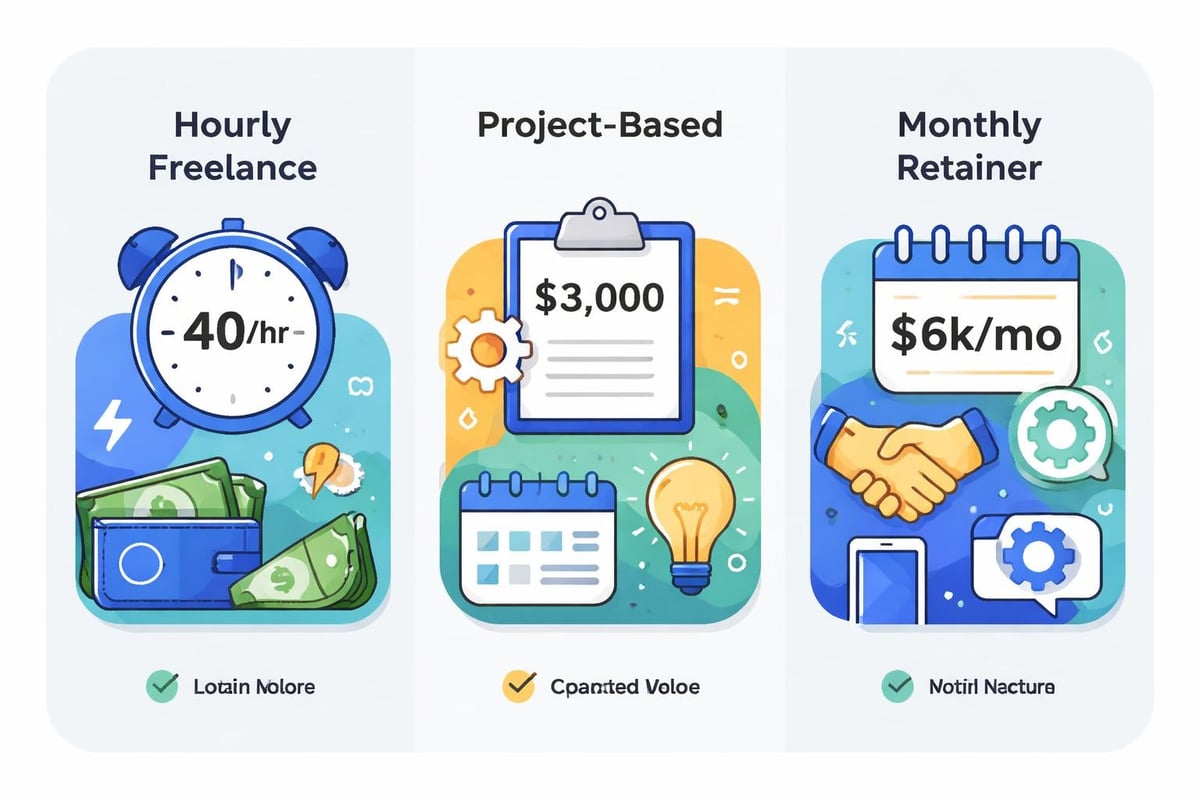
Freelance Hourly Engagement
Hiring individual freelancers on an hourly basis provides maximum flexibility. According to Arc.dev's no-code developer marketplace, freelancers typically charge between $60 and $100+ per hour, with rates adjusted based on project requirements.
Advantages of hourly freelancers:
- Pay only for time actually worked
- Easy to scale up or down
- Access to diverse skill sets
- No long-term commitments
Challenges to consider:
- Availability fluctuations
- Knowledge transfer between projects
- Quality consistency
- Limited accountability for outcomes
Project-Based Fixed Pricing
Some no-code developers prefer fixed-price arrangements where you pay a predetermined amount for specific deliverables. This approach works well for clearly defined projects with minimal scope uncertainty.
Fixed pricing typically costs 10-20% more than equivalent hourly arrangements because developers build in risk premiums. However, it provides budget certainty and shifts project risk to the developer.
Retainer Arrangements
Monthly retainers guarantee developer availability for a set number of hours. This model works exceptionally well for ongoing development needs, maintenance, and iterative improvements.
Typical retainer structures:
- Part-time retainer (40-80 hours/month): $4,000-$12,000
- Full-time retainer (160 hours/month): $12,000-$32,000
- Team retainer (multiple developers): $20,000-$100,000+
Retainers often come with 10-15% discounts compared to ad-hoc hourly rates because they provide developers with income stability and project continuity.
Agency vs Individual Developer Pricing
Choosing between hiring individual no-code developers and engaging with specialized agencies involves trade-offs between cost, capability, and reliability. The no-code developer hourly rate varies considerably between these options.
Individual developers offer the most affordable entry point, with rates starting around $30-$50 per hour for capable mid-level talent. They provide direct communication and can be highly motivated to deliver excellent work for portfolio building.
However, individual developers have capacity limitations, may lack breadth in platform expertise, and represent a single point of failure if they become unavailable. For mission-critical projects, this risk can outweigh cost savings.
No-code development agencies like those specializing in best low-code agencies for outsourcing typically charge $100-$200 per hour, reflecting their overhead, quality processes, and team capabilities. This premium buys you:
- Team redundancy and knowledge sharing
- Established quality assurance processes
- Broader platform and integration expertise
- Project management and coordination
- Guaranteed availability and support
- Professional liability coverage
For enterprises and venture-backed startups where timeline reliability matters as much as cost, agencies often provide better total value despite higher hourly rates.
Evaluating Value Beyond the Hourly Rate
The lowest no-code developer hourly rate doesn't always represent the best value. Smart buyers evaluate developers based on multiple factors that impact total project cost and outcome quality.
Speed and Efficiency
Experienced developers accomplish more in fewer hours. A senior developer at $150/hour who completes your project in 80 hours costs $12,000 total. A junior developer at $40/hour requiring 400 hours costs $16,000 while delivering potentially lower quality results and taking five times longer.
Efficiency indicators to assess:
- Portfolio of similar completed projects
- Platform certifications and specialized training
- Years of experience with specific platforms
- Client testimonials mentioning timeline performance
- Communication clarity and responsiveness
Technical Architecture Quality
Poor architectural decisions early in a project create technical debt that becomes expensive to fix later. Developers who understand scalability, security, and maintainability deliver applications that grow with your business rather than requiring costly rebuilds.
When reviewing no-code tools for SaaS founders, consider whether your developer can guide platform selection based on your long-term needs rather than just their personal preferences.
Business Understanding
The best no-code developers combine technical skills with business acumen. They ask questions about your goals, suggest workflow optimizations, and identify opportunities to solve problems more elegantly than your initial specifications.
This consultative approach adds value beyond basic implementation. A developer who helps you avoid expensive mistakes or identify cost-saving alternatives provides ROI that transcends their hourly rate.
Budgeting for Your No-Code Project
Creating realistic budgets for no-code development requires understanding typical project scopes and hour estimates. While every project differs, general benchmarks help establish expectations.
| Project Type | Estimated Hours | Rate Range | Total Cost Range |
|---|---|---|---|
| Simple MVP | 40-80 hours | $50-$100/hr | $2,000-$8,000 |
| Internal Dashboard | 60-120 hours | $60-$120/hr | $3,600-$14,400 |
| Customer Portal | 100-200 hours | $75-$150/hr | $7,500-$30,000 |
| SaaS Application | 200-400 hours | $90-$175/hr | $18,000-$70,000 |
| Enterprise Solution | 400-800 hours | $120-$200/hr | $48,000-$160,000 |
These estimates assume competent developers working efficiently. Add 20-30% contingency for scope expansion, integration challenges, and revisions based on user feedback.
Budget planning best practices:
- Define clear project scope before soliciting rates
- Get detailed estimates from 3-5 qualified developers
- Verify estimates against similar project portfolios
- Build contingency for inevitable scope adjustments
- Plan for post-launch maintenance (10-20% of build cost annually)
Understanding MVP application requirements helps scope initial versions that validate market fit before investing in full feature sets.
Maximizing ROI from No-Code Development
Getting the most value from your no-code developer investment requires strategic planning and smart project management. The no-code developer hourly rate represents just one component of total project value.
Start with Clear Requirements
Ambiguous requirements lead to scope creep, miscommunication, and wasted hours. Invest time upfront to document:
- User personas and journeys
- Core features vs nice-to-have functionality
- Integration requirements and data sources
- Performance and scalability expectations
- Security and compliance needs
Clear requirements enable accurate estimates and reduce expensive mid-project pivots. Working with developers experienced in application development platforms ensures your requirements translate effectively to platform capabilities.
Prioritize Iterative Development
Rather than building everything at once, launch with core functionality and iterate based on real user feedback. This approach:
- Reduces initial development costs
- Validates assumptions before heavy investment
- Generates revenue or user data sooner
- Maintains development momentum
- Allows budget reallocation based on learnings
Iterative development aligns perfectly with no-code platforms' strength in rapid modification and deployment.
Invest in Proper Documentation
Ensure your developer documents database structures, workflows, integrations, and custom functionality. Quality documentation enables:
- Easier maintenance and updates
- Smoother developer transitions if needed
- Faster onboarding for additional team members
- Better troubleshooting when issues arise
- Knowledge preservation for your organization
Documentation represents a small incremental cost (5-10% of development hours) with disproportionate long-term value.
Future Trends Affecting No-Code Pricing
The no-code developer hourly rate landscape continues evolving as the industry matures and new technologies emerge. Several trends will likely impact pricing through 2026 and beyond.
AI integration capabilities are becoming increasingly important. Developers skilled in implementing AI software development features command premium rates as businesses seek to embed intelligence into their applications.
Platform consolidation may reduce rate variance as dominant platforms emerge and standardize best practices. However, specialization in advanced features of leading platforms will continue commanding premium compensation.
Increased enterprise adoption is driving demand for developers with security, compliance, and integration expertise. These specialized skills justify higher rates as no-code solutions tackle more mission-critical applications.
The growing recognition of no-code development as a legitimate engineering discipline rather than a "coding shortcut" supports sustained or increasing rates for experienced professionals. As enterprises turn to no-code for internal tool development, demand for qualified talent will likely outpace supply.
Understanding the no-code developer hourly rate landscape empowers you to make informed hiring decisions that balance cost, quality, and project success. Whether you're building an MVP, creating internal tools, or developing enterprise solutions, matching your project needs with appropriately experienced talent ensures optimal outcomes. Big House Technologies specializes in delivering scalable no-code and AI solutions using Bubble and Lovable platforms, providing the expertise, reliability, and efficiency that justify strategic investment in quality development partners who understand both the technical capabilities and business implications of every project decision.

About Big House
Big House is committed to 1) developing robust internal tools for enterprises, and 2) crafting minimum viable products (MVPs) that help startups and entrepreneurs bring their visions to life.
If you'd like to explore how we can build technology for you, get in touch. We'd be excited to discuss what you have in mind.
Other Articles
Discover the fastest no-code platforms for startups in 2026. Compare speeds, features, and capabilities to launch your product quickly.
Unlock 2026 success with our enterprise automation consulting guide covering trends, best practices, case studies, and actionable strategies for measurable ROI.
Discover the 2026 landscape of enterprise software development services Explore trends, tech stacks, and best practices to future proof your business success