
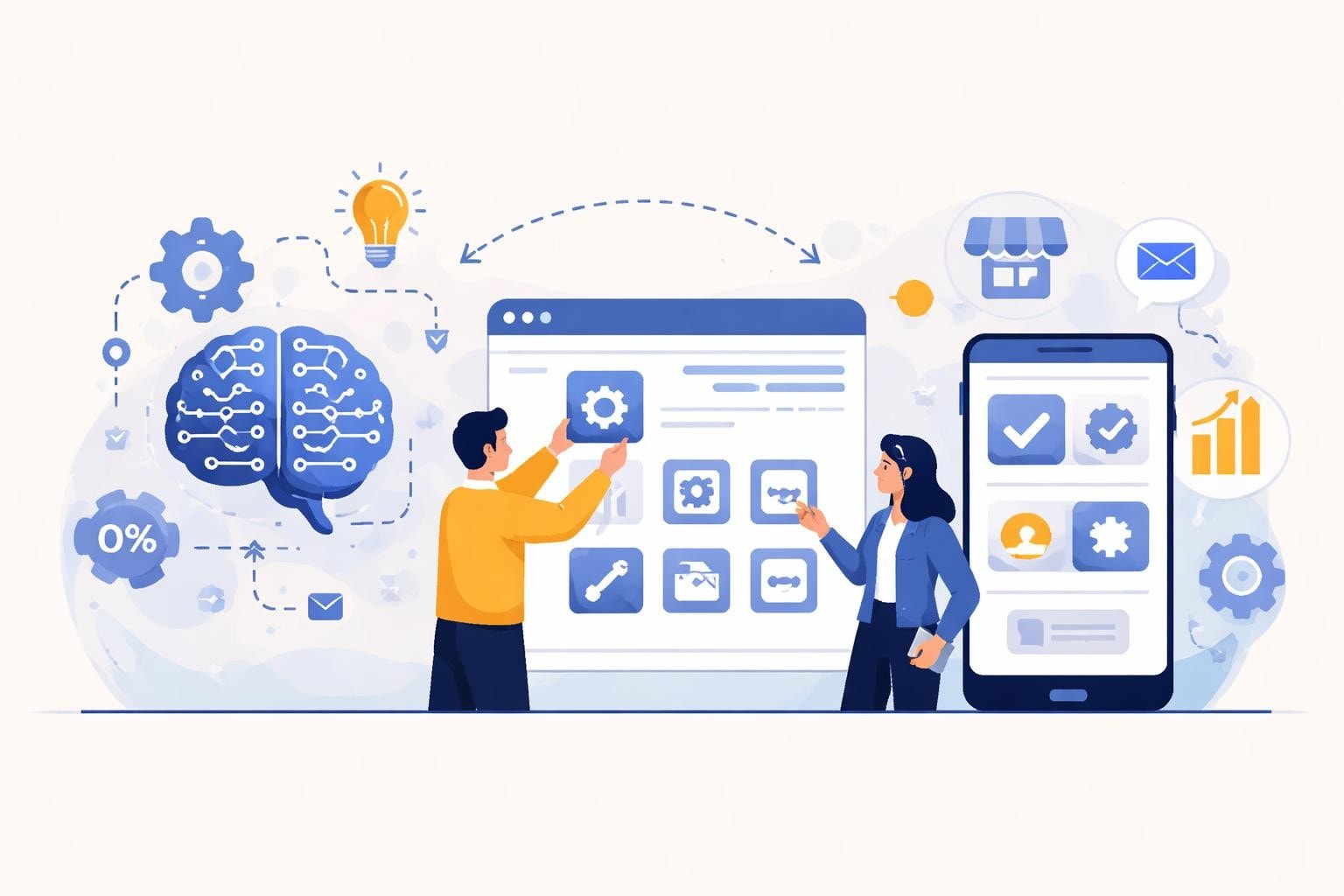
The landscape of software development has undergone a dramatic transformation with the emergence of no-code ai app development platforms. These powerful tools democratize artificial intelligence, allowing businesses to harness machine learning capabilities without requiring extensive programming knowledge or data science expertise. As we move through 2026, enterprises and startups alike are discovering that building intelligent applications no longer demands large technical teams or months of development time. Instead, visual interfaces and pre-built AI components enable rapid deployment of sophisticated solutions that previously would have required significant investment in specialized talent.
Understanding Modern No-Code AI Platforms
No-code ai app development platforms represent a convergence of two revolutionary trends: the no-code movement and artificial intelligence. These platforms provide visual development environments where users can drag and drop components, configure AI models, and build complete applications through intuitive interfaces rather than writing code.
The core advantage lies in accessibility. Product managers, business analysts, and domain experts can now directly build the solutions they envision without relying solely on development teams. This shift accelerates innovation cycles and reduces the communication gap between technical and non-technical stakeholders.
Key Components of AI-Enabled No-Code Tools
Modern platforms combine several essential elements that make AI development approachable:
- Pre-trained AI models for common tasks like image recognition, natural language processing, and predictive analytics
- Visual workflow builders that connect data sources, AI services, and business logic
- Automated data preparation tools that clean and format information for AI consumption
- Testing and deployment pipelines that streamline the journey from prototype to production
These components work together seamlessly, allowing builders to focus on solving business problems rather than wrestling with technical infrastructure. The comprehensive approach from scoping to deployment mirrors what traditional development requires but compresses timelines dramatically.

Top Platform Categories for AI Application Development
The ecosystem of no-code ai app development platforms has matured significantly, with different tools specializing in various use cases and application types. Understanding these categories helps businesses select the right solution for their specific needs.
Database-Centric AI Platforms
Platforms like Airtable have evolved beyond simple spreadsheets to incorporate AI capabilities directly into data management workflows. According to Airtable's overview of no-code AI tools, these solutions excel at organizing information while adding intelligent automation, predictions, and insights.
| Feature | Business Benefit | Common Use Cases |
|---|---|---|
| AI-powered data categorization | Reduces manual data entry by 70-80% | Customer support ticket routing |
| Predictive field completion | Improves data quality and consistency | CRM lead enrichment |
| Automated workflow triggers | Accelerates response times | Inventory management alerts |
These database-first platforms work exceptionally well for operations teams managing large volumes of structured information who need AI assistance without building separate applications.
Multi-Agent Development Environments
Recent innovations have introduced platforms specifically designed for building systems with multiple AI agents working together. Research on AutoGen Studio demonstrates how no-code tools now support debugging and developing complex multi-agent systems that previously required advanced programming skills.
This capability opens new possibilities for creating sophisticated AI assistants that can handle multi-step processes, collaborate on tasks, and provide more nuanced responses than single-agent systems.
Function-as-a-Service Integration Platforms
Emerging approaches like LLM4FaaS combine large language models with serverless computing, enabling users to describe applications in natural language and have them automatically translated into functional code. This represents the cutting edge of no-code ai app development platforms, where the platform itself uses AI to build AI applications.
Enterprise vs. Startup Considerations
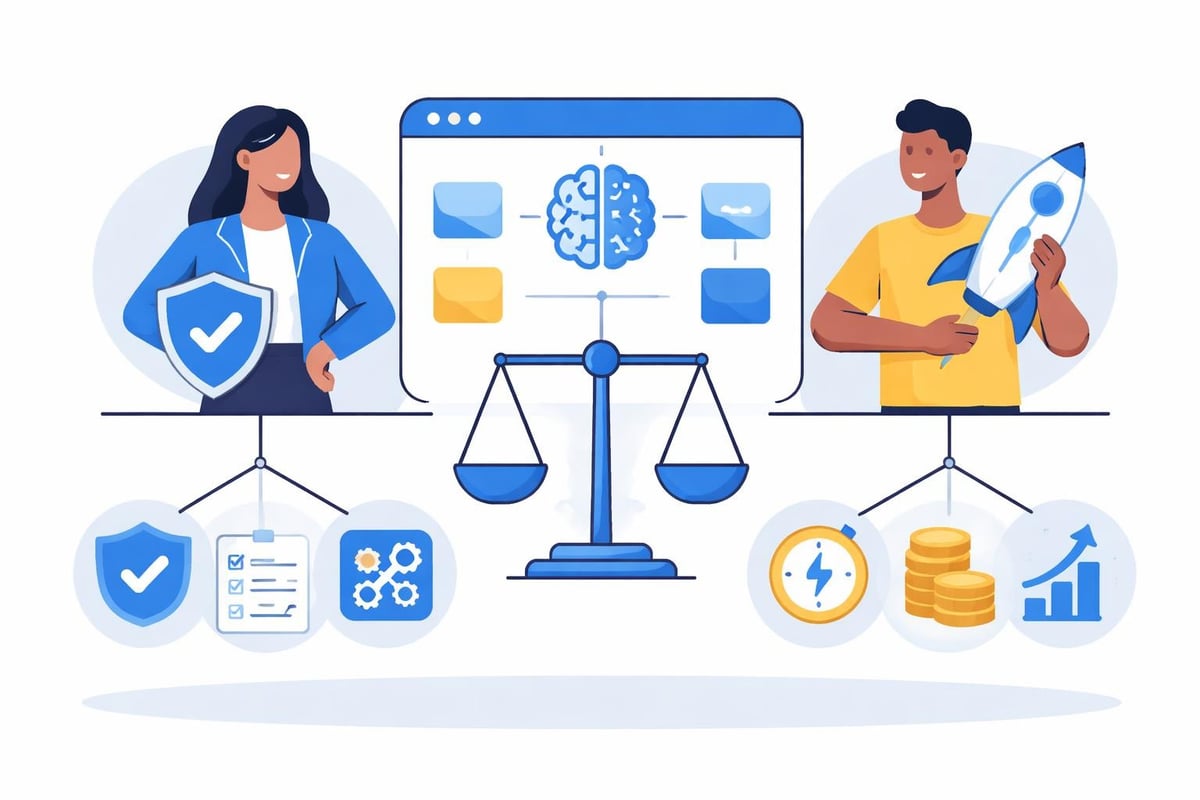
Different organizations have distinct requirements when selecting no-code AI platforms. Enterprises prioritize security, compliance, and integration with existing systems, while startups often emphasize speed to market and cost efficiency.
Enterprise Requirements
Security and compliance dominate enterprise decision-making. Platforms must offer:
- Role-based access controls and audit logging
- Data residency options for regulated industries
- Single sign-on integration with corporate identity systems
- Service level agreements with uptime guarantees
Integration capabilities become critical when AI applications need to work with existing enterprise software. The ability to connect with enterprise integration platforms determines whether a no-code solution can truly serve as a production-grade tool rather than just a prototyping environment.
Startup Optimization
Startups building with no-code ai app development platforms focus on different priorities. Speed and cost matter most when racing to validate product-market fit or meet investor milestones.
- Rapid iteration cycles allow testing multiple approaches quickly
- Pay-as-you-grow pricing preserves precious runway
- Built-in scaling infrastructure prevents technical debt as user bases expand
Many successful no-code startups have built their initial products entirely on these platforms, only adding custom code for specialized features after achieving significant traction.
Building Intelligent Applications Without Code
The practical process of building with no-code ai app development platforms differs significantly from traditional development but still requires thoughtful planning and design.
Application Architecture on No-Code Platforms
Even without writing code, developers must think through architecture. Applications typically consist of:
Data layer - Where information is stored and structured Logic layer - How data flows and transforms through AI models Presentation layer - How users interact with AI capabilities
Platforms like Bubble, which Big House Technologies specializes in, provide robust frameworks for all three layers. When combined with AI capabilities, these platforms enable building MVPs rapidly while maintaining the flexibility to scale and evolve.
AI Model Selection and Configuration
Most platforms offer pre-built AI capabilities organized by function:
| AI Capability | Platform Implementation | Business Applications |
|---|---|---|
| Natural language understanding | API connections to GPT-4, Claude | Chatbots, content analysis, sentiment detection |
| Image recognition | Integration with Vision AI services | Product identification, quality control, security |
| Predictive analytics | Built-in ML model training | Demand forecasting, churn prediction, pricing optimization |
| Recommendation engines | Collaborative filtering tools | Product suggestions, content personalization |
The key decision involves matching business requirements to available AI capabilities, then configuring parameters like confidence thresholds, training data sources, and output formats.
Data Pipeline Design
AI applications require clean, well-structured data. No-code platforms simplify this through:
- Automated data connectors that pull from APIs, databases, and spreadsheets
- Transformation tools that normalize formats and handle missing values
- Validation rules that ensure data quality before AI processing
Research on Trinity, a no-code AI platform for complex spatial datasets, demonstrates how specialized tools can handle even sophisticated data scenarios without requiring programming expertise.
Common Use Cases Across Industries
No-code ai app development platforms have proven particularly effective for specific application types that appear across multiple industries.
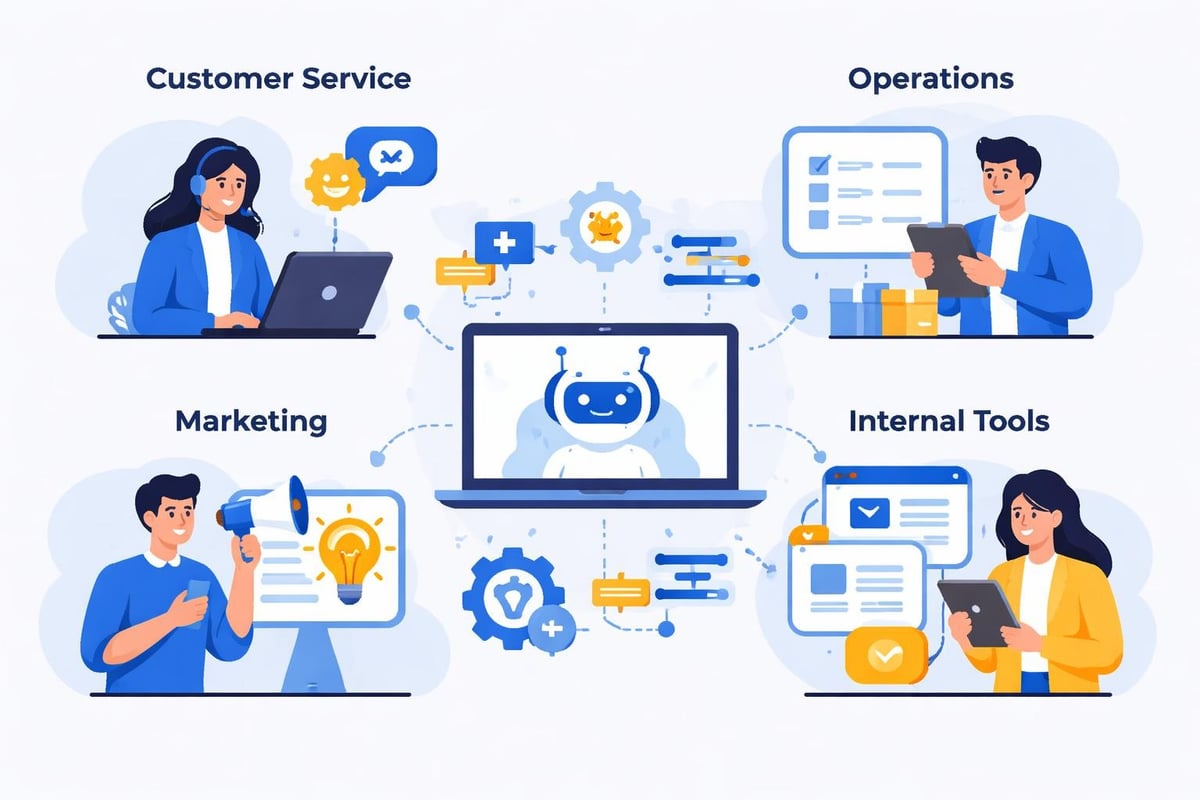
Customer Service Automation
Intelligent chatbots and support ticket routing represent the most common AI application built on no-code platforms. These systems can:
- Understand customer inquiries using natural language processing
- Route requests to appropriate departments or agents
- Provide automated responses for common questions
- Escalate complex issues with relevant context
The best chat GPT apps often combine no-code platforms with AI APIs to create sophisticated conversational interfaces without custom development.
Internal Operations Tools
Many organizations use no-code AI to build internal dashboards that provide intelligent insights to employees:
- Sales teams receive lead scoring predictions
- Operations managers get inventory optimization recommendations
- HR departments access resume screening and candidate matching
- Finance teams monitor anomaly detection for fraud prevention
These internal tools deliver immediate ROI by augmenting employee capabilities without the cost and complexity of traditional enterprise software implementations.
Content and Marketing Applications
Marketing teams have embraced no-code ai app development platforms for:
Content generation tools that draft copy variations A/B testing platforms with AI-powered optimization Personalization engines that customize user experiences Analytics dashboards with predictive insights
The combination of AI-powered no-code development tools enables marketing teams to build and iterate on campaigns faster than ever before.
Platform Evaluation Criteria
Selecting the right platform requires evaluating multiple factors beyond basic features. Smart evaluation prevents costly platform switches and ensures long-term success.
Technical Capabilities Assessment
Start by mapping your requirements against platform capabilities:
- AI model variety - Does the platform support the specific AI functions you need?
- Customization depth - Can you fine-tune models or only use pre-configured options?
- Performance metrics - What are typical response times and accuracy levels?
- Scalability limits - How many users, transactions, or data points can the platform handle?
Platforms reviewed in top no-code AI software development platforms offer varying levels of sophistication, from simple AI integrations to comprehensive development environments.
Integration and Extensibility
No application exists in isolation. Evaluate how platforms connect with:
- External data sources through API connections and webhooks
- Third-party services via pre-built integrations
- Custom code when no-code limitations require traditional programming
- Legacy systems that remain critical to business operations
The ability to extend beyond pure no-code becomes important as applications mature and requirements evolve.
Cost Structure Analysis
Pricing models vary dramatically across no-code ai app development platforms:
| Pricing Model | Advantages | Disadvantages | Best For |
|---|---|---|---|
| Per-user subscription | Predictable costs | Expensive at scale | Small teams, internal tools |
| Usage-based metering | Pay only for what you use | Unpredictable monthly bills | Variable workloads |
| Tiered feature access | Clear upgrade path | Feature restrictions frustrating | Growing businesses |
| Flat-rate unlimited | Simple budgeting | Overpaying at low usage | High-volume applications |
Understanding total cost of ownership includes platform fees, AI API costs, and ongoing maintenance requirements.
Development Workflows and Best Practices
Success with no-code ai app development platforms requires adopting appropriate workflows that balance speed with quality.
Agile Development on No-Code Platforms
The rapid iteration possible with no-code tools aligns perfectly with agile methodologies:
Sprint planning focuses on user stories achievable within platform capabilities Daily standups review progress without technical blockers Demo sessions showcase working features to stakeholders immediately Retrospectives identify platform limitations requiring workarounds
This approach mirrors traditional software project management but accelerates timelines by eliminating coding bottlenecks.
Testing AI Applications
AI introduces unique testing challenges that no-code platforms must address:
- Model accuracy validation using test datasets
- Edge case identification where AI fails unexpectedly
- Bias detection ensuring fair outcomes across user groups
- Performance monitoring tracking response times and resource usage
Platforms like AIAP integrate natural language input with visual workflows to simplify testing complex AI services even for non-technical users.
Version Control and Documentation
Even without traditional code, maintaining version history and documentation remains critical:
- Platform-native versioning features track changes over time
- External documentation captures business logic and decision rationales
- Change logs communicate updates to stakeholders
- Backup strategies protect against data loss or platform issues
Future Trends in No-Code AI Development
The trajectory of no-code ai app development platforms points toward even greater sophistication and accessibility in the coming years.
Natural Language Programming
The next evolution involves describing applications entirely in natural language and having AI platforms generate complete solutions. Early examples show promise, but production-ready implementations require further refinement.
Voice-based development interfaces may soon allow building applications through conversation rather than clicking and dragging visual components.
Automated Optimization
Platforms increasingly use AI to optimize the applications built on them:
- Performance auto-tuning adjusts configurations for speed
- Cost optimization recommends efficient resource allocation
- UX enhancement suggests interface improvements based on user behavior
- Security hardening identifies and fixes vulnerabilities automatically
Industry-Specific Solutions
Generic platforms are being supplemented by specialized tools targeting specific industries. Healthcare, finance, manufacturing, and retail each have unique requirements that purpose-built platforms address more effectively than general-purpose tools.
The top no-code AI app builders in 2025 included several vertical-specific platforms, a trend accelerating through 2026.
Overcoming Common Challenges
Despite their power, no-code ai app development platforms present challenges that builders must navigate strategically.
Platform Lock-in Concerns
Data portability becomes critical when considering platform switches. Evaluate:
- Export formats and completeness
- Migration tools availability
- API access to underlying data
- Ownership rights to created applications
Mitigation strategies include architecting with abstraction layers, maintaining external documentation, and choosing platforms with open APIs.
Scaling Limitations
No-code platforms eventually hit limits where custom code becomes necessary. Recognizing these thresholds early prevents costly rearchitecture:
- Complex business logic exceeding platform capabilities
- Performance requirements beyond platform optimization
- Unique integrations lacking pre-built connectors
- Regulatory requirements needing custom implementation
Understanding no-code vs. custom code cost comparisons helps make informed decisions about when to transition.
Skill Development Needs
While no-code platforms eliminate programming requirements, they introduce their own learning curves:
Platform-specific expertise develops through hands-on experience AI literacy helps users understand model capabilities and limitations Design thinking remains essential for creating valuable solutions Data management skills ensure applications built on quality information
Organizations should invest in training and consider partnering with specialized agencies that bring platform expertise to projects.
Platform Ecosystem and Community
The strength of no-code ai app development platforms extends beyond features to include communities, marketplaces, and support resources.
Template Marketplaces
Pre-built templates accelerate development by providing starting points for common applications:
- Customer relationship management systems
- Project management tools
- E-commerce storefronts
- Analytics dashboards
Templates reduce development time from weeks to hours while demonstrating best practices and platform capabilities.
Developer Communities
Active communities provide invaluable resources:
- Forums where builders share solutions to common challenges
- Tutorial libraries explaining advanced techniques
- Plugin marketplaces extending platform capabilities
- Expert directories connecting users with consultants
Platforms with vibrant ecosystems often prove more valuable than those with slightly better features but limited community support.
Professional Services Networks
Many organizations partner with agencies specializing in specific platforms. These partnerships provide:
Implementation expertise accumulated across multiple projects Best practice guidance preventing common mistakes Accelerated timelines through experienced teams Ongoing support after initial deployment
The comprehensive resources available through top no-code AI platforms demonstrate how ecosystem strength differentiates leading solutions.
No-code ai app development platforms have fundamentally changed how organizations approach building intelligent applications, making sophisticated AI capabilities accessible to businesses of all sizes. Whether you're an enterprise seeking faster internal tool development or a startup racing to validate your product concept, these platforms offer compelling advantages in speed, cost, and flexibility. Big House Technologies specializes in leveraging Bubble and Lovable platforms to build scalable AI-powered solutions that transform your ideas into production-ready applications, delivering the expertise and comprehensive support needed to maximize the potential of no-code development.

About Big House
Big House is committed to 1) developing robust internal tools for enterprises, and 2) crafting minimum viable products (MVPs) that help startups and entrepreneurs bring their visions to life.
If you'd like to explore how we can build technology for you, get in touch. We'd be excited to discuss what you have in mind.
Other Articles
Discover the 2025 guide to enterprise app development services, covering trends, technologies, and partner selection to drive digital transformation and growth.
Low-code vs. no-code in 2025: Learn the key differences, benefits, and limitations to choose the right platform for your business and accelerate digital transformation.
Build a powerful bubble website in 2026 with our complete guide covering planning, design, integrations, scaling, and expert tips for future-proof success.