
The landscape of software development has fundamentally shifted over the past few years, and coding with AI has emerged as one of the most transformative forces in the industry. Developers, engineers, and businesses are discovering that AI-powered coding tools don't just speed up development-they fundamentally change how we approach problem-solving, quality assurance, and team collaboration. Whether you're building enterprise applications, rapid prototypes, or scalable platforms, understanding how to effectively leverage AI in your coding workflow has become essential for staying competitive in 2026.
The Evolution of AI-Assisted Development
Coding with AI represents more than just autocomplete on steroids. Modern AI coding assistants understand context, generate entire functions, debug complex issues, and even suggest architectural improvements. The technology has matured from simple snippet suggestions to comprehensive development partners that can reason about code structure, security vulnerabilities, and performance optimization.
From Automation to Intelligence
Traditional coding automation focused on repetitive tasks-formatting code, running tests, or deploying applications. Today's AI tools go several steps further:
- Contextual code generation that understands your entire codebase, not just the current file
- Intelligent refactoring suggestions that improve code quality and maintainability
- Natural language to code translation that bridges the gap between idea and implementation
- Automated testing creation that identifies edge cases developers might miss
According to IBM's analysis of AI-powered coding tools, organizations implementing AI assistance in their development workflows report significant reductions in technical debt and faster time-to-market for new features.
The shift is particularly pronounced in enterprise environments where scalable backend development requires both speed and reliability. AI coding assistants help teams maintain consistency across large codebases while enabling individual developers to work more efficiently.
Key Benefits Transforming Development Teams
When organizations adopt coding with AI strategically, they unlock advantages that extend far beyond faster typing. The impact touches every phase of the software development lifecycle, from initial planning through deployment and maintenance.
Productivity Gains and Time Savings
The numbers tell a compelling story. Recent industry reports indicate that top engineering teams are doubling their output with AI coding tools. Nearly two-thirds of code production has shifted to AI generation, with projections suggesting this could reach 90% within a year.
But raw productivity isn't the only metric that matters:
| Benefit Category | Traditional Approach | AI-Assisted Approach | Impact |
|---|---|---|---|
| Routine Functions | 30-45 minutes | 5-10 minutes | 70-80% reduction |
| Bug Identification | 1-2 hours | 15-30 minutes | 60-75% reduction |
| Documentation | Often skipped | Auto-generated | Near 100% completion |
| Code Review Cycles | 2-3 iterations | 1-2 iterations | 33-50% fewer cycles |
Quality and Consistency Improvements
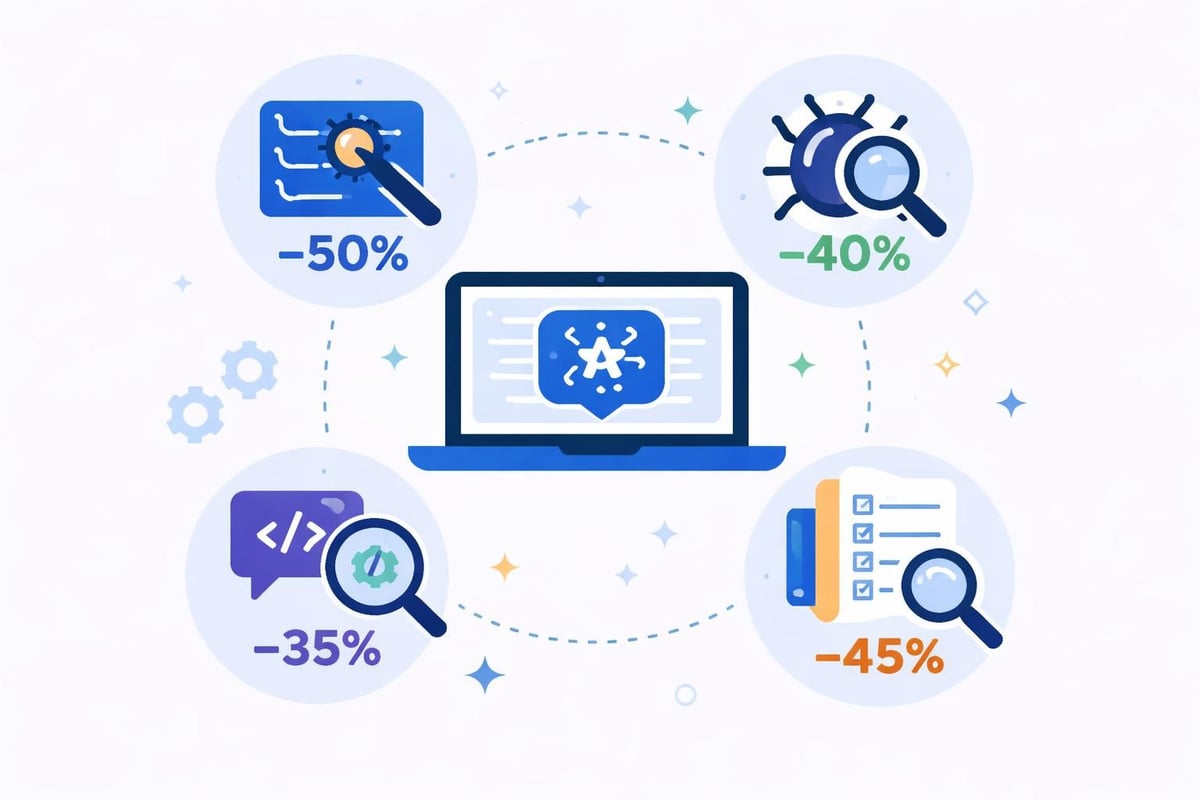
AI coding tools excel at maintaining coding standards across teams. They catch common mistakes before they enter version control, suggest best practices based on current frameworks, and help enforce architectural patterns that might otherwise require extensive documentation and training.
For teams working on MVP software development, this consistency proves invaluable. When multiple developers contribute to a rapid prototype, AI assistance ensures the codebase remains coherent and maintainable even under tight deadlines.
Practical Applications Across Development Scenarios
Coding with AI adapts to various development contexts, from learning environments to enterprise production systems. Understanding where AI assistance provides maximum value helps teams implement it strategically.
Onboarding and Skill Development
New developers joining a team face a steep learning curve-understanding the codebase, learning frameworks, and absorbing team conventions. Code.org's curriculum on coding with AI demonstrates how AI tools accelerate this learning process by explaining complex concepts, suggesting improvements, and generating examples.
When a junior developer encounters an unfamiliar pattern, they can ask the AI assistant to explain the code's purpose, suggest alternative approaches, and identify potential issues. This real-time mentorship supplements traditional training without overwhelming senior developers with constant questions.
Rapid Prototyping and Validation
Speed to market determines success for many products. AI coding tools compress the timeline from concept to working prototype by handling boilerplate code, setting up infrastructure, and implementing standard features.
Consider a startup validating a new business model. Instead of spending weeks building authentication, database schemas, and API endpoints, developers can describe requirements in natural language and let AI generate initial implementations. The team then focuses on unique business logic and user experience-the differentiators that matter.
AI-powered no-code development tools take this concept even further, enabling non-technical founders to participate directly in the development process. The combination of no-code platforms and AI assistance democratizes software creation without sacrificing sophistication.
Enterprise Integration and Maintenance
Large organizations maintain extensive legacy systems that require constant updates and integration with modern platforms. Coding with AI helps bridge technological generations by understanding older codebases and suggesting modernization paths.
- Converting deprecated APIs to current standards
- Translating between programming languages during migration projects
- Generating integration code for connecting disparate systems
- Documenting undocumented legacy code through analysis
The Associated Press reports that AI is transforming how companies approach software maintenance, automating routine updates while freeing engineers to focus on architectural improvements and innovation.
Best Practices for Effective AI-Assisted Coding
Success with coding with AI requires more than installing tools and hoping for magic. Development teams need clear strategies for integration, quality control, and continuous improvement.
Establishing Clear Workflows
- Define AI's role in your development process-where it assists versus where humans lead
- Set quality gates that require human review for critical code paths
- Create feedback loops where developers rate AI suggestions to improve accuracy
- Document patterns that AI handles well versus areas requiring caution
- Train teams on effective prompt engineering and AI collaboration techniques
InfoWorld's developer insights emphasize that the most successful teams treat AI as a collaborative partner rather than a replacement. They develop workflows where AI handles repetitive tasks while developers focus on creative problem-solving and architectural decisions.
Security and Code Review Considerations
AI-generated code requires the same scrutiny as human-written code-if not more. Establish processes that catch potential security vulnerabilities, licensing issues, and performance problems:
- Static analysis tools that scan all code regardless of origin
- Dependency auditing to track third-party libraries AI suggestions might introduce
- Performance profiling to ensure AI-generated implementations meet efficiency requirements
- Security reviews focusing on authentication, data handling, and access control
The University of Oxford's AI Competency Centre guidance provides frameworks for evaluating AI-generated code systematically, ensuring quality standards remain consistent.
Emerging Trends Shaping the Future
The field of coding with AI continues evolving rapidly. Several trends are reshaping how developers work and what they can accomplish.
Vibe Coding and Natural Language Development
Vibe coding represents a paradigm shift where developers describe desired functionality in natural language, and AI translates those descriptions into working code. This approach reduces the barrier between idea and implementation, allowing non-developers to contribute meaningfully to software projects.
For agencies like those specializing in AI software development, vibe coding expands the potential client base. Business stakeholders can participate directly in defining application behavior without needing to learn traditional programming syntax.
Multimodal AI Development Tools
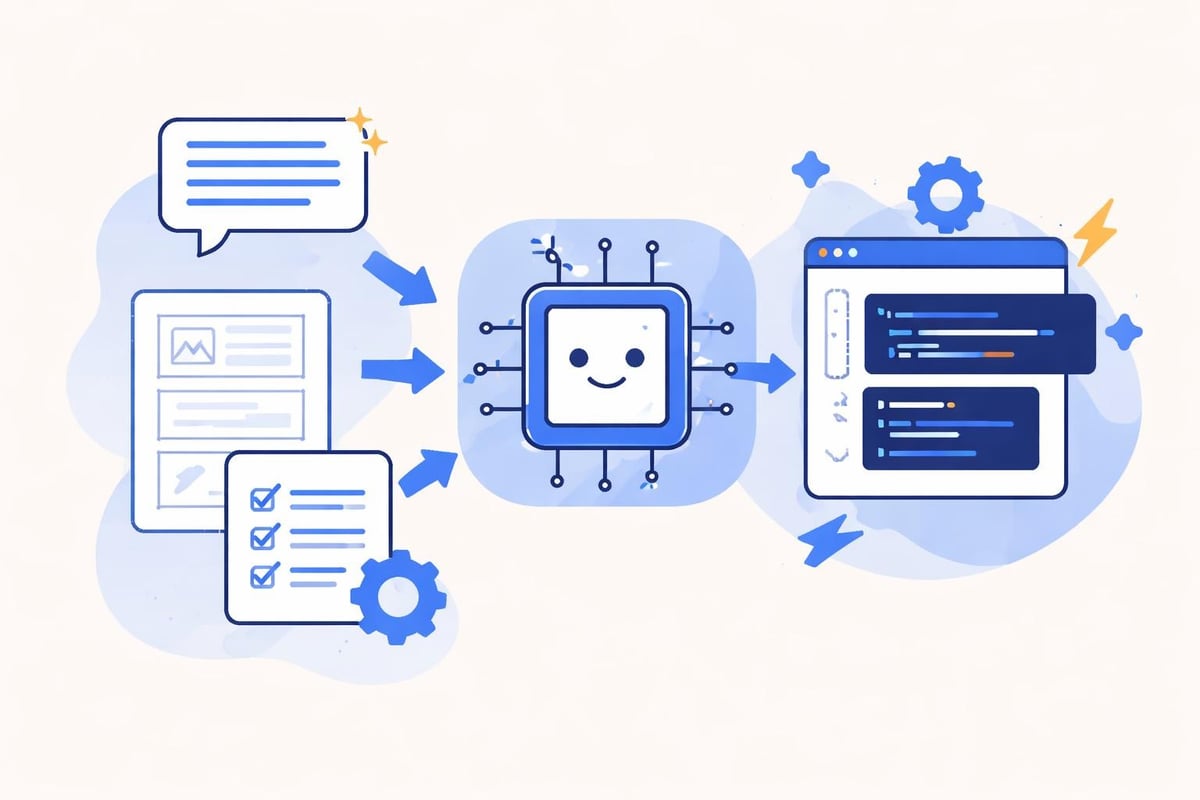
Modern AI coding assistants now process multiple input types-code snippets, natural language descriptions, diagrams, and even screenshots of desired interfaces. AWS's overview of AI code generation highlights how these multimodal capabilities enable more intuitive development experiences.
Developers can sketch an interface, describe its behavior, and receive functional code that implements the design. This tight integration between design and development accelerates iteration cycles and reduces miscommunication between teams.
AI-Driven Testing and Quality Assurance
Testing has traditionally consumed significant development time. AI tools now generate comprehensive test suites automatically, identifying edge cases that manual testing might miss. They analyze code paths, generate test data, and even suggest additional test scenarios based on similar codebases.
The impact on development velocity is substantial:
| Testing Phase | Manual Approach | AI-Assisted Approach |
|---|---|---|
| Unit Test Creation | 20-30% of development time | 5-10% of development time |
| Integration Test Coverage | 60-70% typical | 85-95% achievable |
| Edge Case Identification | Depends on developer experience | Systematic analysis |
| Regression Test Updates | Manual synchronization | Automatic generation |
Choosing the Right AI Coding Tools
Not all AI coding assistants offer the same capabilities or fit every development context. Microsoft's beginner guide to coding with AI helps developers understand what features matter most for their specific needs.
Key Features to Evaluate
Context awareness determines how well the AI understands your specific codebase. Tools that analyze entire repositories provide more relevant suggestions than those limited to individual files.
Language and framework support varies significantly between platforms. Ensure your chosen tool supports your technology stack comprehensively, including newer frameworks and specialized libraries.
Integration capabilities affect daily workflow efficiency. The best AI coding tools integrate seamlessly with your existing IDE, version control system, and deployment pipeline.
Customization options allow teams to train AI models on internal codebases and coding standards. This personalization improves suggestion relevance and reduces time spent rejecting inappropriate recommendations.
Privacy and security features protect proprietary code and sensitive data. Enterprise teams should prioritize tools offering on-premises deployment or robust data protection guarantees.
Implementation Strategies for Teams
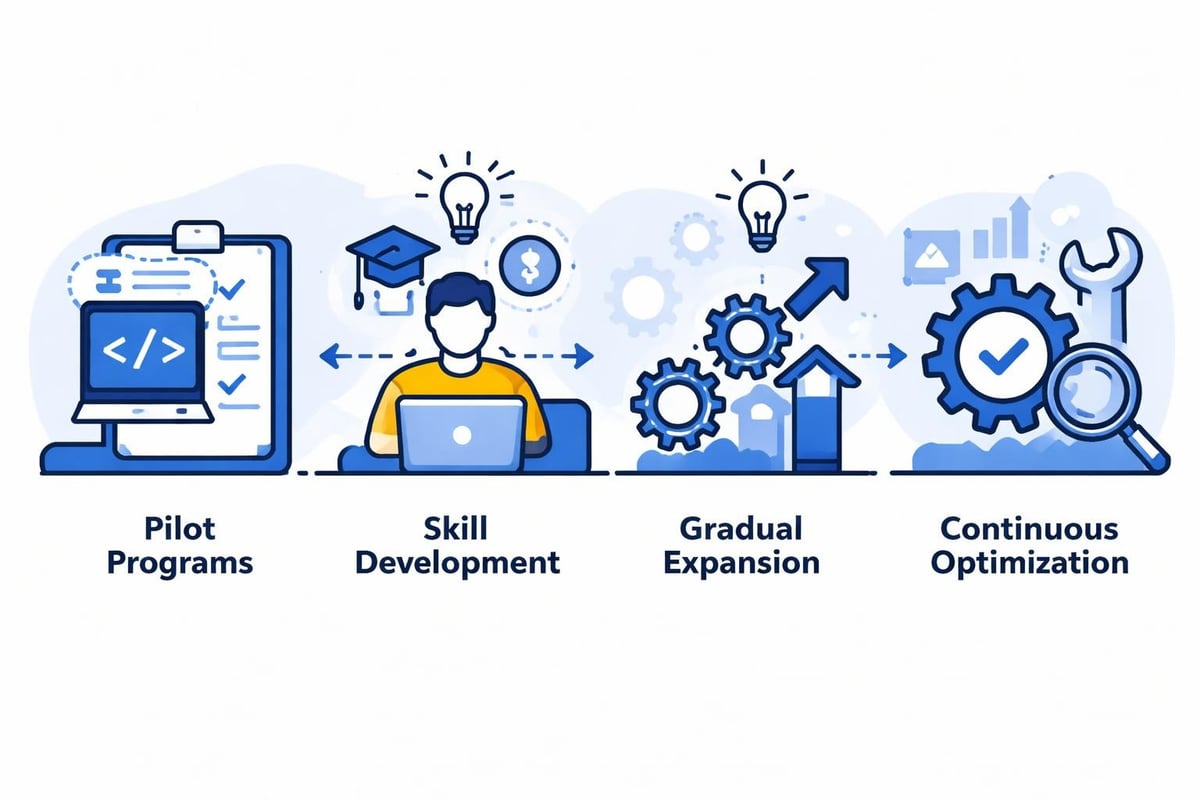
Starting with coding with AI doesn't require wholesale workflow changes. Successful implementations typically follow a phased approach:
- Pilot programs with a small team exploring AI tools on non-critical projects
- Skill development through training sessions and knowledge sharing
- Gradual expansion as teams develop confidence and best practices
- Continuous optimization based on feedback and performance metrics
Organizations working with UI/UX and development agencies often find that external partners bring valuable experience in AI tool implementation, accelerating adoption and avoiding common pitfalls.
Balancing AI Assistance with Developer Expertise
While coding with AI delivers impressive capabilities, the most successful outcomes combine AI efficiency with human creativity and judgment. Developers remain essential for architectural decisions, user experience considerations, and business logic that requires domain expertise.
Where AI Excels
AI coding tools handle repetitive patterns exceptionally well. They generate boilerplate code, implement standard algorithms, and convert between data formats with minimal errors. These capabilities free developers from tedious work, allowing them to focus on problems requiring innovation.
Configuration files, API integrations, and database migrations-all areas where accuracy matters more than creativity-benefit enormously from AI assistance. The tools rarely make typos, consistently follow conventions, and complete these tasks in seconds rather than minutes.
Where Human Expertise Remains Critical
Complex business logic, user experience design, and system architecture require understanding that extends beyond code patterns. Developers evaluate trade-offs, consider long-term maintenance implications, and make decisions based on organizational context that AI tools cannot fully grasp.
When building software design for enterprise clients, architects must consider scalability requirements, regulatory compliance, integration constraints, and political factors within the organization. AI assists with implementation, but humans drive strategic decisions.
Measuring Success with AI Coding Tools
Teams need concrete metrics to evaluate whether coding with AI delivers promised benefits. Tracking the right indicators helps optimize tool usage and justify continued investment.
Quantitative Metrics
Development velocity measured through story points completed, features shipped, or lines of functional code provides baseline productivity assessment. Compare pre-AI and post-AI implementation periods, controlling for project complexity.
Code quality metrics including bug density, technical debt ratio, and maintainability scores indicate whether AI assistance maintains standards. Track these continuously to catch quality degradation early.
Time allocation analysis reveals how developers spend their hours. Successful AI implementation should increase time spent on creative problem-solving while reducing time on repetitive tasks.
Review efficiency metrics track how many code review cycles required before merging. AI tools that catch issues early should reduce review iterations.
Qualitative Indicators
Developer satisfaction surveys capture whether teams feel AI tools help or hinder their work. High satisfaction correlates with effective implementation and proper training.
Learning curve observations show how quickly new team members become productive. AI assistance should accelerate onboarding by providing contextual help and examples.
Innovation output assessment examines whether teams propose more creative solutions when freed from routine coding tasks. This subjective measure indicates whether AI unlocks higher-value work.
Integration with No-Code and Low-Code Platforms
The convergence of coding with AI and no-code platforms creates powerful possibilities for rapid application development. Organizations can leverage both approaches based on project requirements and team capabilities.
Complementary Strengths
No-code platforms like Bubble handle visual development and standard features efficiently. When custom functionality is required, AI coding tools can generate the necessary code extensions quickly. This hybrid approach maximizes speed while maintaining flexibility.
For businesses exploring AI tools for Bubble developers, AI-assisted coding complements visual development by handling complex plugins, custom API integrations, and advanced data transformations that exceed no-code platform capabilities.
Strategic Platform Selection
| Requirement | Best Approach | Reasoning |
|---|---|---|
| Standard CRUD operations | No-code platform | Faster visual development |
| Complex algorithms | AI-assisted coding | Precise control and optimization |
| Rapid prototyping | Hybrid approach | Speed of no-code with custom AI-generated features |
| Enterprise integrations | AI-assisted coding | Custom connection logic and transformation |
Understanding when to use each tool maximizes efficiency. Teams skilled in both approaches can tackle a broader range of projects while maintaining consistent quality and delivery speed.
Future-Proofing Your Development Practice
As AI capabilities expand, development practices must evolve to remain effective. Organizations investing in coding with AI today position themselves for continued advancement as tools become more sophisticated.
Continuous Learning and Adaptation
The AI coding tool landscape changes rapidly. What seemed impossible six months ago becomes routine. Development teams need structures for continuous learning-regular tool evaluations, experimentation time, and knowledge sharing sessions.
Stay informed about emerging tools and capabilities through industry publications, conference attendance, and peer networks. Early adoption of transformative tools provides competitive advantages.
Experiment systematically with new features and approaches. Allocate time for developers to explore AI capabilities beyond immediate project needs.
Document learnings from both successes and failures. Build organizational knowledge about what works in your specific context.
Building Flexible Processes
Rigid development processes struggle to accommodate rapidly evolving tools. Create frameworks that allow quick integration of new capabilities while maintaining quality standards. Define principles rather than prescriptive steps-focus on outcomes like "all code must be reviewed" rather than "code must be reviewed in specific tool X."
For companies working with agencies building Bubble MVPs, this flexibility proves crucial. The best partners adapt quickly to new tools and techniques, continuously improving delivery speed and quality.
Coding with AI has transformed from experimental novelty to essential development practice in 2026, offering unprecedented productivity gains while maintaining or improving code quality. By implementing AI tools strategically, establishing clear workflows, and balancing automation with human expertise, development teams unlock new levels of efficiency and innovation. Whether you're building enterprise applications, rapid prototypes, or specialized software solutions, Big House Technologies combines AI-assisted development with no-code platforms to deliver scalable solutions faster and more cost-effectively than traditional approaches-let's discuss how we can accelerate your next project.

About Big House
Big House is committed to 1) developing robust internal tools for enterprises, and 2) crafting minimum viable products (MVPs) that help startups and entrepreneurs bring their visions to life.
If you'd like to explore how we can build technology for you, get in touch. We'd be excited to discuss what you have in mind.
Other Articles
Discover the future of QA software development in 2025. Explore trends, tools, AI, best practices, and step-by-step strategies to ensure software excellence.
Master build tooling in 2025 with this beginner-friendly guide. Learn key concepts, choose the right tools, and set up efficient workflows for faster development.
Master your next dev project with our 2025 step-by-step guide. Learn scoping, tools, team setup, testing, and deployment for efficient, future-proof delivery.