
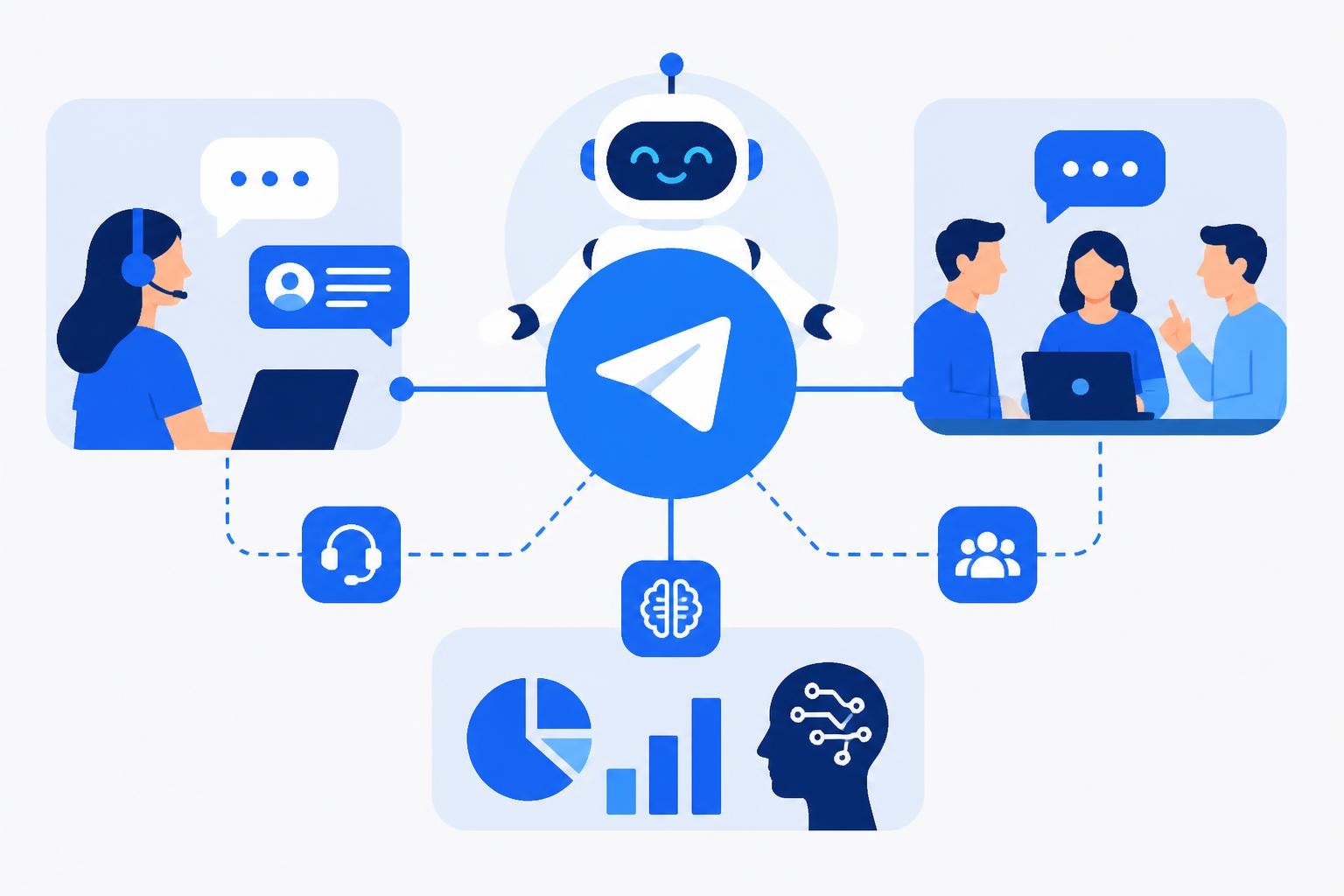
Telegram has evolved from a simple messaging app into a powerful platform for AI integration, enabling businesses to automate workflows, enhance customer engagement, and streamline operations without writing a single line of code. As we navigate through 2026, the convergence of AI capabilities with Telegram's robust API has created unprecedented opportunities for enterprises and startups to build intelligent conversational interfaces. The rise of ai telegram solutions represents a fundamental shift in how organizations approach customer service, internal communication, and data management, making sophisticated AI accessible to non-technical teams through no-code platforms.
The Evolution of AI Telegram Integration
The integration of artificial intelligence into Telegram has transformed dramatically over the past few years. What started as basic chatbots has evolved into sophisticated AI agents capable of understanding context, managing complex workflows, and providing personalized experiences at scale.
Modern ai telegram implementations leverage natural language processing, machine learning models, and conversational AI to create experiences that feel genuinely intelligent. Unlike traditional chatbots that rely on rigid decision trees, today's AI-powered Telegram bots can understand nuance, remember conversation history, and adapt their responses based on user behavior.
Key capabilities that define modern AI Telegram bots include:
- Natural language understanding across multiple languages
- Context retention throughout extended conversations
- Integration with external databases and APIs
- Automated task execution based on user intent
- Predictive analytics for proactive engagement
- Voice message transcription and analysis
The platform's flexibility has made it particularly attractive for businesses seeking alternatives to more complex enterprise communication tools. Elon Musk's xAI partnership with Telegram demonstrates the growing recognition of Telegram as a viable platform for cutting-edge AI deployment.
No-Code AI Telegram Development Strategies
Building AI-powered Telegram bots no longer requires extensive programming knowledge. The emergence of ai-powered no-code development tools has democratized access to sophisticated bot creation, enabling business teams to prototype and deploy functional AI assistants in days rather than months.
Platform Selection and Architecture
Choosing the right development approach for your ai telegram project depends on several factors including budget, timeline, technical expertise, and scalability requirements.
| Development Approach | Time to Deploy | Cost Range | Technical Skill Required | Scalability |
|---|---|---|---|---|
| No-Code Platforms | 1-2 weeks | $500-$5,000 | Low | Medium-High |
| Low-Code Solutions | 2-4 weeks | $5,000-$20,000 | Medium | High |
| Custom Development | 6-12 weeks | $20,000+ | High | Very High |
| Hybrid Approach | 3-6 weeks | $10,000-$30,000 | Medium-High | Very High |
For startups and enterprises looking to validate concepts quickly, low-cost MVP development tools provide the perfect balance between functionality and investment. These platforms allow teams to build, test, and iterate on AI Telegram integrations without committing to expensive custom development.
The key is understanding your use case. Simple customer service bots might only need basic natural language processing and FAQ matching. More complex implementations like Overfolder's personal AI assistant require deeper integrations with calendars, email systems, and task management tools.
Integration Workflows and Data Architecture
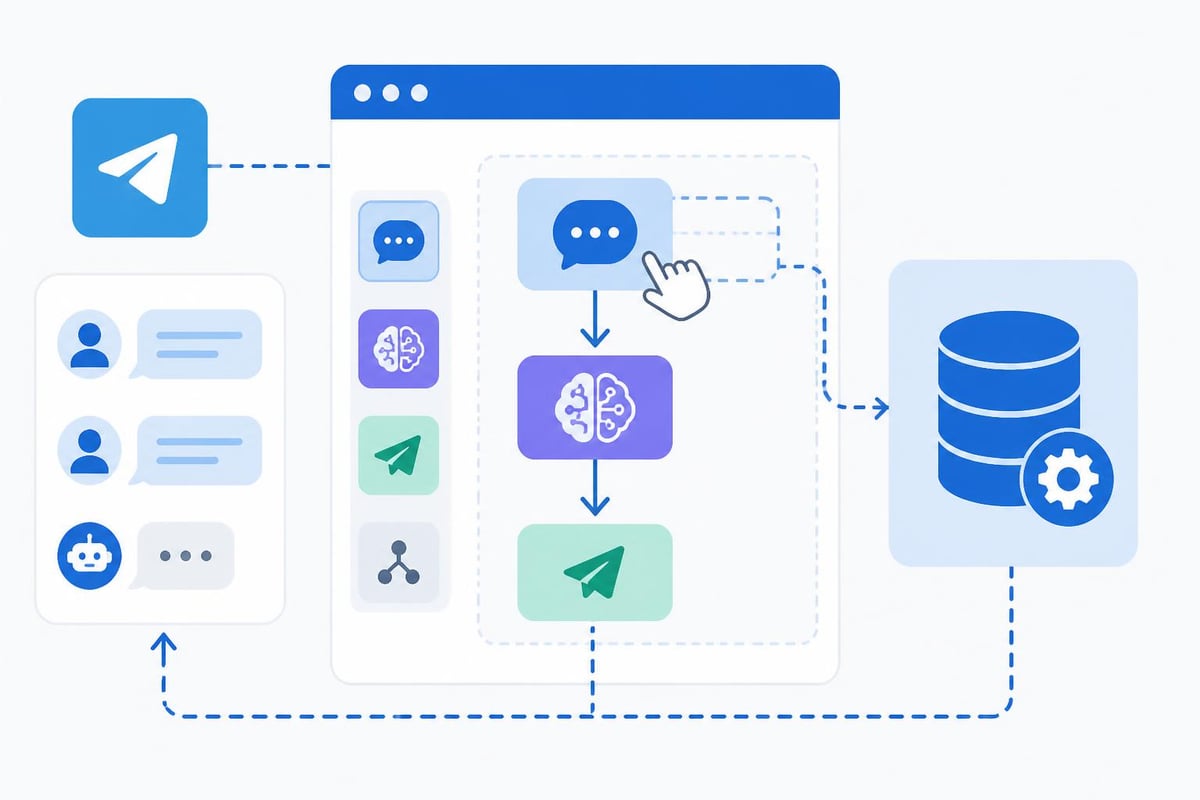
Successfully implementing an ai telegram solution requires careful planning of data flows and system integrations. Modern no-code platforms excel at connecting disparate systems through pre-built connectors and API integrations.
Essential integration points include:
- Authentication systems for user verification and access control
- Database connections for storing conversation history and user preferences
- Third-party APIs for extending functionality beyond core Telegram features
- Analytics platforms for tracking engagement and performance metrics
- CRM systems for maintaining customer relationships across channels
These integrations become particularly powerful when combined with AI capabilities. For instance, an AI assistant can query your CRM, analyze customer history, and provide personalized recommendations within a Telegram conversation. Platforms like Andrew J. Pyle offer educational resources that help teams understand how to architect these AI-driven workflows effectively.
Practical AI Telegram Applications for Business
The real value of ai telegram technology emerges through practical applications that solve genuine business challenges. Organizations across industries are discovering innovative ways to leverage AI-powered Telegram bots for competitive advantage.
Customer Support and Service Automation
Customer service represents one of the most compelling use cases for AI Telegram integration. Traditional support channels struggle with scalability, consistency, and 24/7 availability. AI-powered Telegram bots address these limitations while maintaining the personal touch customers expect.
Advanced implementations like TeleClaw bring ChatGPT-style intelligence directly into Telegram conversations, enabling sophisticated query handling without complex setup procedures. These bots can handle common inquiries, escalate complex issues to human agents, and maintain conversation context across multiple interactions.
Benefits of AI-powered Telegram support include:
- Instant response times regardless of inquiry volume
- Consistent answer quality across all customer interactions
- Multilingual support without hiring specialized agents
- Automated ticket creation and routing for complex issues
- Integration with knowledge bases for accurate information retrieval
The cost savings can be substantial. Organizations report 40-60% reduction in support ticket volume after implementing intelligent ai telegram assistants, allowing human agents to focus on high-value interactions that require empathy and creative problem-solving.
Internal Team Collaboration and Productivity
Beyond customer-facing applications, ai telegram tools are revolutionizing internal team workflows. Smart assistants can manage meeting scheduling, track project deadlines, distribute reports, and facilitate cross-functional communication.
Tools like Gienji demonstrate how AI companions can enhance team intelligence through voice message understanding and inline responses. These capabilities transform Telegram from a simple messaging app into a comprehensive productivity platform.

Consider these internal use cases:
| Use Case | AI Capability | Business Impact |
|---|---|---|
| Meeting Scheduling | Natural language date/time parsing | 70% reduction in scheduling time |
| Status Updates | Automated report compilation | 5 hours saved per team weekly |
| Knowledge Management | Semantic search across documents | 50% faster information retrieval |
| Task Assignment | Intelligent workload distribution | 30% improvement in capacity planning |
Organizations building these internal tool solutions find that Telegram's familiar interface reduces training time and accelerates adoption compared to specialized enterprise software.
Information Digesting and Content Curation
The information overload problem has intensified as organizations expand their digital presence across multiple channels. AI telegram bots excel at filtering, summarizing, and curating relevant information for busy professionals.
Aillo exemplifies this approach by reading chat conversations and providing clean digests at regular intervals. Rather than scrolling through hundreds of messages, team members receive intelligent summaries highlighting decisions, action items, and critical updates.
This becomes particularly valuable for enterprises managing multiple Telegram groups across departments, projects, or geographic regions. The AI can identify patterns, surface emerging issues, and ensure important information doesn't get lost in high-volume channels.
Building Your AI Telegram Strategy
Successfully implementing ai telegram solutions requires more than just technical execution. Organizations need strategic frameworks that align AI capabilities with business objectives while managing change effectively.
Defining Success Metrics and KPIs
Before deploying any AI Telegram solution, establish clear metrics for measuring success. Vague goals like "improve customer service" lack the specificity needed for iterative improvement.
Effective KPIs for AI Telegram implementations:
- Response accuracy rate - Percentage of queries handled correctly without human intervention
- Average resolution time - Time from initial contact to issue resolution
- User satisfaction scores - Direct feedback through post-interaction surveys
- Deflection rate - Percentage of inquiries resolved by AI versus escalated to humans
- Engagement metrics - Active users, message volume, and session duration
- Cost per interaction - Total operational cost divided by total interactions handled
These metrics enable data-driven optimization of your ai telegram implementation. Application development platforms typically include built-in analytics dashboards that track these KPIs automatically.
Privacy, Security, and Compliance Considerations
Implementing AI on Telegram requires careful attention to data privacy and security regulations, particularly for organizations handling sensitive customer information or operating in regulated industries.
The platform's end-to-end encryption capabilities provide strong security foundations, but organizations must consider additional factors. Where is conversation data stored? How long is it retained? Who has access to training data used for AI model improvement?
Research into Telegram's ecosystem challenges highlights the importance of implementing robust verification systems and content moderation when deploying AI bots at scale. Organizations should establish clear data governance policies before deployment.
Security best practices include:
- Implementing user authentication and authorization protocols
- Encrypting data at rest and in transit
- Regular security audits of bot permissions and access controls
- Compliance documentation for GDPR, CCPA, and industry-specific regulations
- Transparent privacy policies explaining data usage
These considerations become especially important when building solutions that integrate with enterprise systems containing proprietary business data or personally identifiable information.

Advanced AI Telegram Capabilities in 2026
The ai telegram landscape continues to evolve rapidly with new capabilities emerging throughout 2026. Understanding these advanced features helps organizations future-proof their implementations and maintain competitive advantages.
Multimodal AI Integration
Modern AI Telegram bots extend beyond text-based interactions to include voice, images, documents, and video. This multimodal approach creates richer user experiences and expands the range of problems AI can solve effectively.
Voice message transcription has become particularly valuable, allowing users to communicate naturally while AI processes and responds to spoken queries. Document analysis capabilities enable bots to extract information from PDFs, spreadsheets, and presentations shared within conversations.
Image recognition allows AI to provide visual context understanding, from product identification in customer service scenarios to quality control in manufacturing environments. These capabilities, previously requiring custom application development, are now accessible through no-code platforms.
Contextual Intelligence and Memory
The most sophisticated ai telegram implementations maintain conversation context across extended timeframes, remembering user preferences, previous interactions, and established relationships. This contextual intelligence transforms one-off exchanges into ongoing relationships.
Unlike traditional chatbots that treat each conversation independently, advanced AI agents build user profiles that inform future interactions. They recognize returning users, recall previous issues or purchases, and anticipate needs based on historical patterns.
This capability proves especially valuable for enterprise applications where customer relationships span months or years. The AI becomes progressively more helpful as it accumulates interaction history, creating competitive moats that are difficult for new entrants to replicate.
Proactive Engagement and Predictive Analytics
The next frontier for ai telegram technology involves shifting from reactive response to proactive engagement. Rather than waiting for users to initiate conversations, intelligent bots can anticipate needs and reach out with timely, relevant information.
Proactive engagement scenarios include:
- Notifying customers when products they've browsed go on sale
- Alerting team members when project deadlines approach
- Suggesting optimal times for scheduling based on calendar analysis
- Identifying potential customer churn signals and triggering retention workflows
- Recommending resources based on detected knowledge gaps
These predictive capabilities require sophisticated data analysis, but the payoff in user engagement and satisfaction justifies the investment. Organizations leveraging the TeraGram dataset can study engagement patterns to optimize their proactive messaging strategies.
Implementation Roadmap and Best Practices
Launching an ai telegram solution successfully requires methodical planning and execution. Organizations that rush deployment often encounter adoption challenges, technical debt, and user resistance.
Phase 1: Discovery and Requirements Gathering
Begin by thoroughly understanding the problem you're solving and the users who will benefit from your AI Telegram solution. Conduct stakeholder interviews, map current workflows, and identify pain points that AI can address effectively.
This discovery phase should produce detailed documentation including user personas, use case scenarios, integration requirements, and success criteria. Internal tool developers emphasize the importance of this foundation work before any development begins.
Phase 2: Prototype and Validation
Build a minimal viable product focused on core functionality rather than comprehensive features. The goal is validating assumptions and gathering real user feedback as quickly as possible.
No-code platforms excel during this phase, enabling rapid iteration based on user testing. Deploy your prototype to a small user group, collect feedback systematically, and refine the experience before broader rollout.
Phase 3: Scaling and Optimization
Once core functionality proves valuable, focus shifts to scaling infrastructure, expanding features, and optimizing performance. This phase requires careful monitoring of system metrics and user behavior analytics.
Optimization priorities typically include:
- Response latency reduction through caching and infrastructure scaling
- Accuracy improvement through training data refinement
- Feature expansion based on user request frequency
- Integration depth with existing business systems
- Personalization enhancement using accumulated user data
Organizations working with enterprise-focused development agencies benefit from expertise in managing this scaling process while maintaining system stability and user experience quality.
Continuous Improvement Framework
AI Telegram implementations should never be considered "finished." Establish processes for ongoing enhancement driven by user feedback, performance data, and emerging AI capabilities.
Regular review cycles should assess bot performance against established KPIs, identify new use cases emerging from user behavior, and incorporate technological advances into your implementation. This commitment to continuous improvement ensures your ai telegram solution remains competitive and valuable over time.
Monthly analytics reviews, quarterly feature assessments, and annual strategic evaluations create a rhythm of improvement that compounds value year after year. The most successful implementations treat their AI Telegram bots as living products that evolve alongside their organizations.
AI Telegram integration represents a powerful opportunity for businesses to enhance communication, automate workflows, and deliver exceptional user experiences without extensive technical overhead. By leveraging no-code platforms and strategic implementation frameworks, organizations can deploy sophisticated AI solutions that scale with their growth. Whether you're building customer service automation, internal productivity tools, or intelligent assistants, Big House Technologies combines expertise in no-code development and AI platforms to transform your vision into fully functional products delivered on time and within budget.

About Big House
Big House is committed to 1) developing robust internal tools for enterprises, and 2) crafting minimum viable products (MVPs) that help startups and entrepreneurs bring their visions to life.
If you'd like to explore how we can build technology for you, get in touch. We'd be excited to discuss what you have in mind.
Other Articles
Master the app runwayml in 2025 with this step by step expert guide covering features setup creative workflows pricing tips and troubleshooting for creators.
Discover how Claude AI for coding revolutionizes software development with intelligent automation, enhanced productivity, and seamless integration.
Learn how to hire bubble product team experts for your no-code projects. Discover roles, skills, and strategies to build high-performing Bubble teams.