
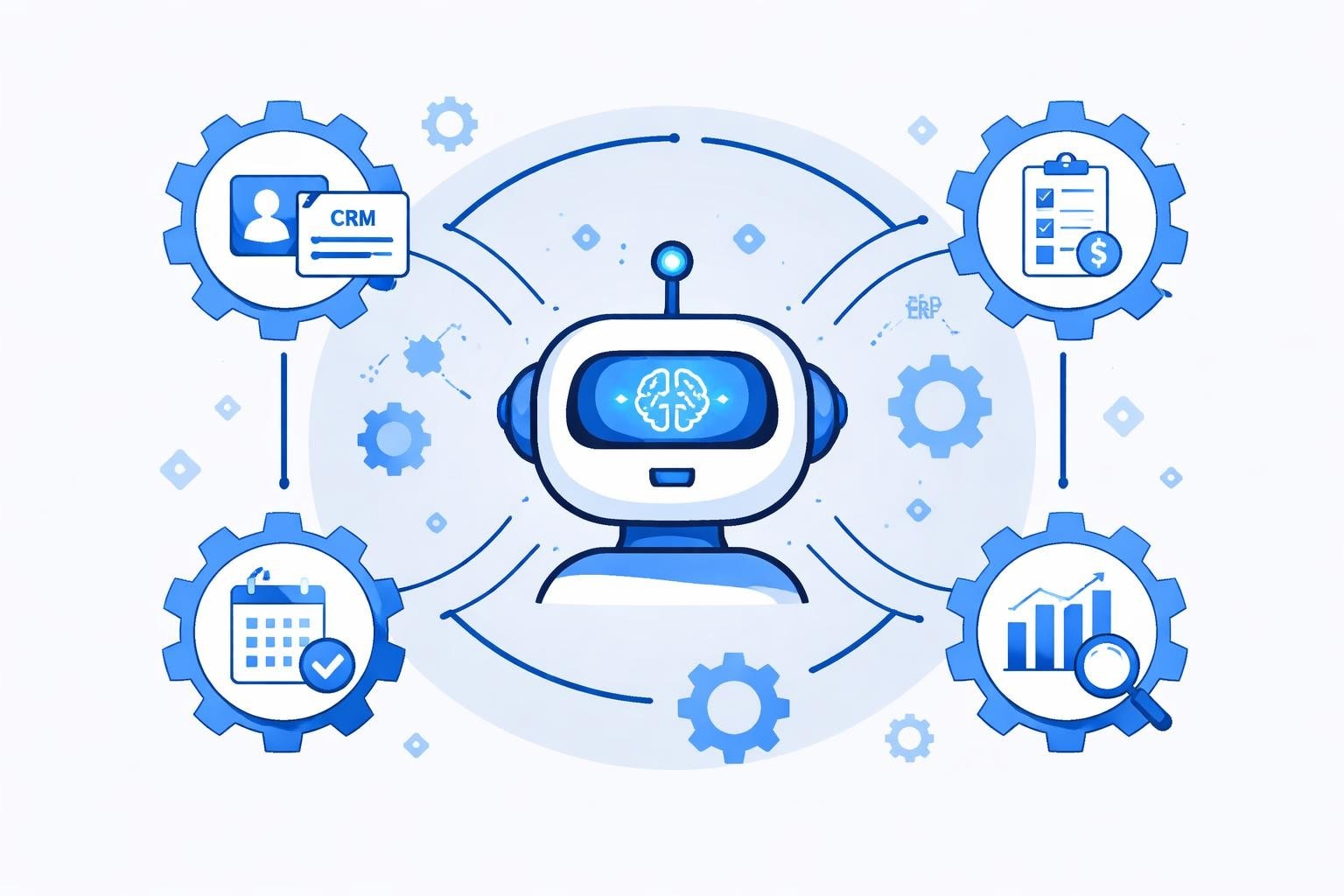
Enterprise software teams face mounting pressure to deliver more value with fewer resources. Manual processes drain productivity, while legacy systems struggle to keep pace with modern business demands. AI automation for enterprise apps represents a fundamental shift in how organizations build, deploy, and manage their critical software infrastructure. By embedding intelligent automation directly into business applications, companies can eliminate repetitive tasks, accelerate decision-making, and create adaptive systems that learn from usage patterns. This transformation doesn't require massive IT overhauls or year-long implementation cycles, especially when leveraging modern no-code platforms that integrate AI capabilities from day one.
Understanding AI Automation in Enterprise Contexts
AI automation for enterprise apps extends far beyond simple task scheduling or basic workflow triggers. Modern enterprise automation combines artificial intelligence agents with business logic to create systems that can interpret context, make decisions, and adapt to changing conditions without human intervention.
The distinction between traditional automation and AI-powered automation lies in cognitive capability. Where conventional robotic process automation follows rigid if-then rules, AI automation interprets unstructured data, recognizes patterns, and responds to novel situations. This difference becomes critical when dealing with enterprise complexity.
Key Components of Enterprise AI Automation
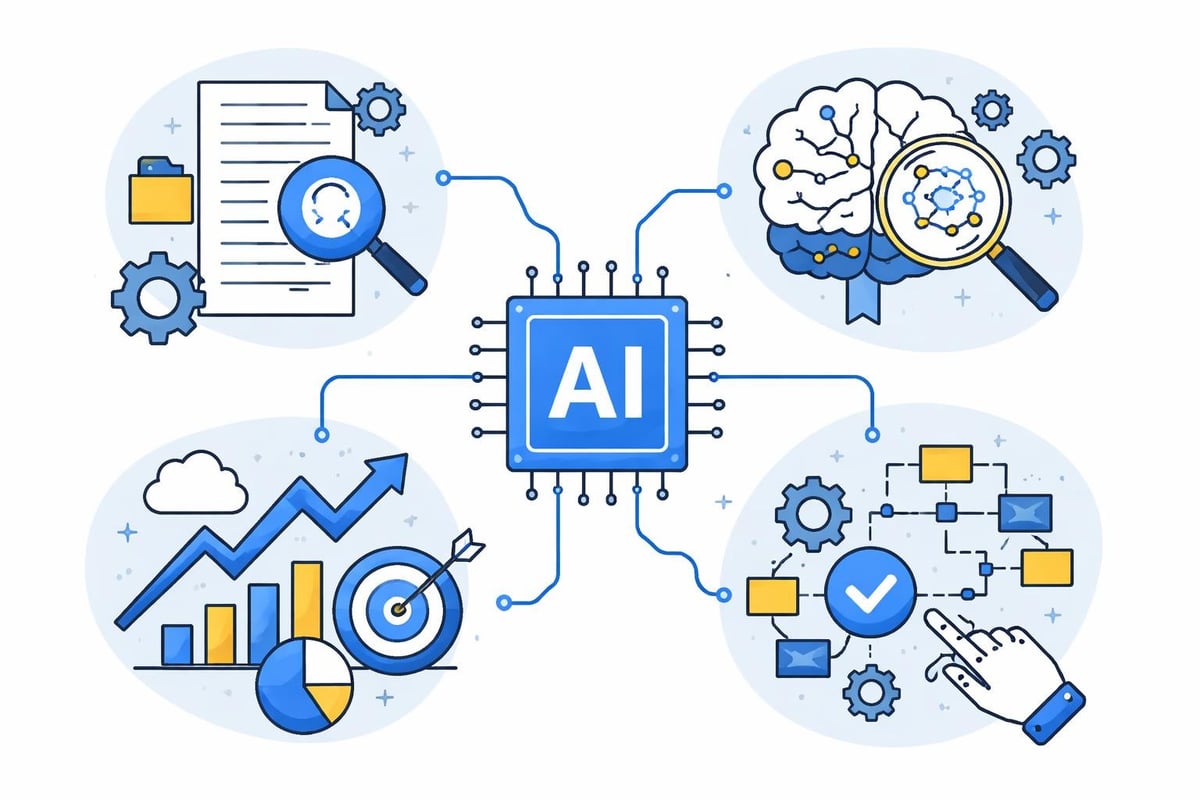
Modern AI automation systems comprise several interconnected layers:
- Natural language processing for document analysis and communication
- Machine learning models that improve through usage
- Predictive analytics for forecasting and resource allocation
- Computer vision for processing visual data and documents
- Decision engines that combine AI insights with business rules
These components work together to create what many call intelligence engines, systems that provide real-time intelligence across enterprise operations. The technology stack supporting these capabilities has matured significantly, making implementation accessible even for organizations without dedicated AI research teams.
Business Process Transformation Through AI
The practical application of ai automation for enterprise apps manifests most clearly in day-to-day business processes. Organizations report dramatic improvements when AI handles routine cognitive work previously requiring human judgment.
Consider financial operations within ERP systems. Traditional approaches require employees to manually review transactions, categorize expenses, and flag anomalies. AI-powered systems can perform these tasks automatically while learning organizational preferences and adapting to new transaction types. Research on AI-enabled orchestration in enterprise systems demonstrates how healthcare enterprises achieve 70% faster processing times through intelligent automation.
Workflow Optimization Across Departments
Different departments benefit from AI automation in distinct ways:
| Department | Manual Process | AI-Automated Process | Time Saved |
|---|---|---|---|
| Finance | Invoice processing and approval routing | Automatic extraction, validation, and routing | 65-75% |
| HR | Resume screening and interview scheduling | Intelligent candidate matching and automated coordination | 50-60% |
| Sales | Lead qualification and follow-up | Predictive scoring and personalized outreach timing | 40-55% |
| Operations | Inventory forecasting and reordering | Demand prediction and automated procurement | 55-70% |
When implementing enterprise integration platforms using no-code approaches, these AI capabilities can be configured rather than coded, dramatically reducing deployment time from months to weeks.
Real-Time Decision Support
AI automation excels at providing context-aware recommendations during active workflows. Instead of requiring users to consult separate analytics dashboards or wait for reports, intelligent systems surface relevant insights at decision points.
A procurement officer reviewing a purchase order might automatically receive supplier performance data, alternative vendor suggestions, and predicted delivery timeframes. The system learns which factors matter most for different purchase categories and adapts its recommendations accordingly. This embedded intelligence transforms how employees interact with enterprise applications.
Implementation Strategies for Enterprise Scale
Successfully deploying ai automation for enterprise apps requires thoughtful planning around both technical architecture and organizational change. The most effective implementations follow a progressive approach rather than attempting organization-wide transformation simultaneously.
Start with high-volume, rule-intensive processes that create measurable bottlenecks. These initial targets offer clear success metrics while building organizational confidence in AI systems. Early wins create momentum for broader adoption and help identify which teams will champion automation initiatives.
Choosing the Right Development Approach
Organizations face a critical decision between traditional custom development and modern no-code platforms. The landscape has evolved considerably, with platforms like Bubble and Lovable enabling sophisticated AI integrations without extensive coding.
Traditional development advantages:
- Complete customization for unique requirements
- Direct control over every system component
- Ability to optimize for specific performance requirements
No-code development advantages:
- Faster deployment cycles (weeks vs. months)
- Lower total cost of ownership
- Built-in AI and integration capabilities
- Easier maintenance and updates
- Reduced dependency on specialized developers
For most enterprises, particularly those focused on building MVPs with no-code approaches, the speed and flexibility advantages outweigh customization constraints. No-code platforms have matured to handle enterprise-grade security, scalability, and compliance requirements.
Data Architecture Considerations
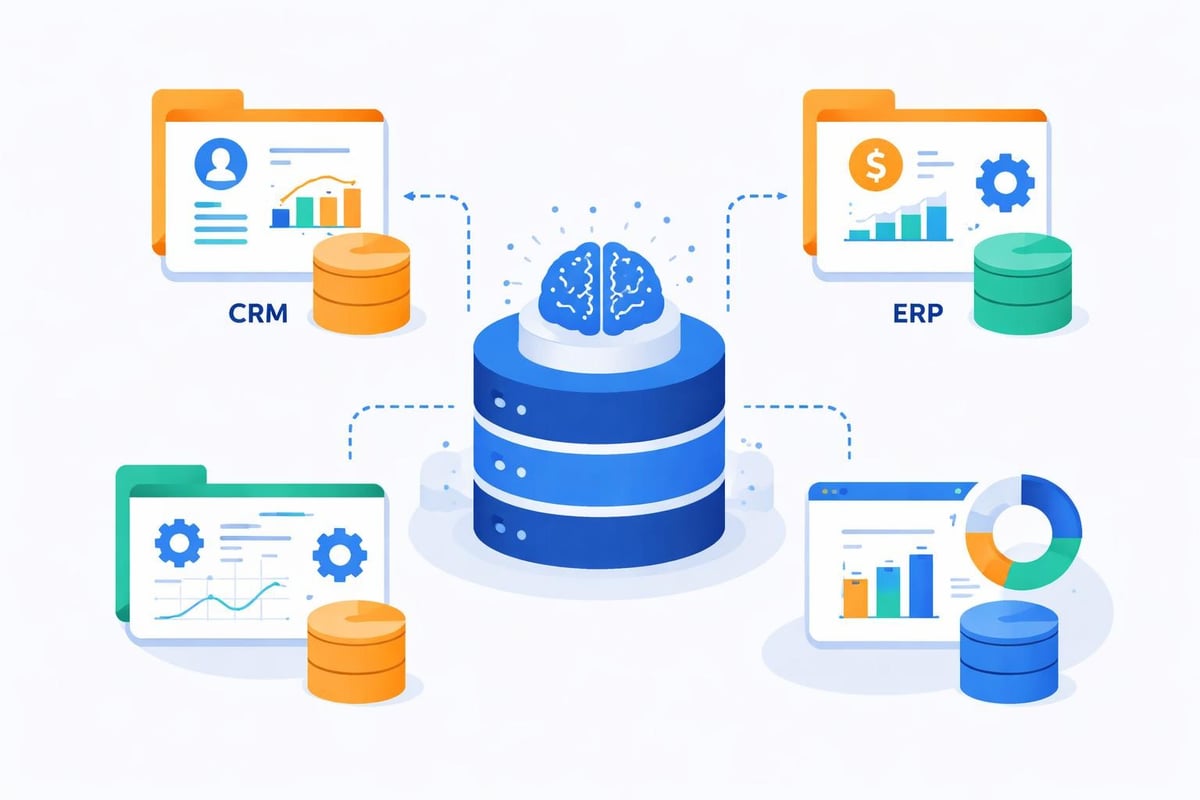
AI automation depends entirely on data accessibility and quality. Before implementing intelligent automation, organizations must address several foundational questions:
- Where does critical business data currently reside? (CRM, ERP, databases, spreadsheets)
- How consistent is data formatting across systems? (standardization gaps create AI challenges)
- What data governance policies apply? (privacy, security, retention requirements)
- How will automated systems access required data? (APIs, direct database connections, file transfers)
These questions reveal whether an organization needs preliminary data consolidation work before AI automation delivers full value. Modern application development platforms often include data management features that simplify this preparation.
AI-Enhanced User Experiences in Enterprise Apps
Beyond backend process automation, AI transforms how employees interact with enterprise software. The shift from complex interfaces requiring extensive training toward intuitive, conversational experiences represents one of the most significant advances in enterprise software usability.
Natural language interfaces allow users to query systems, trigger workflows, and retrieve information using everyday language rather than learning specialized commands or navigation paths. An operations manager might simply ask "Which suppliers are experiencing delivery delays this month?" instead of running multiple reports and cross-referencing data.
Intelligent Assistance Within Applications
Modern enterprise apps increasingly embed AI assistants that provide contextual help and proactive suggestions. These capabilities include:
- Autocomplete predictions based on historical patterns and current context
- Smart form filling that anticipates required information
- Anomaly detection flagging unusual entries or patterns
- Next-best-action recommendations guiding users through complex processes
- Automated documentation capturing decisions and rationale
Companies like Pegasystems with their Blueprint tool demonstrate how AI agents can optimize entire application workflows by analyzing usage patterns and suggesting improvements. This creates a continuous improvement cycle where applications become more effective over time.
Personalization at Enterprise Scale
AI automation for enterprise apps enables personalization previously impossible in business software. Systems learn individual user preferences, working styles, and typical tasks to customize interfaces and prioritize information accordingly.
A sales representative sees different dashboard widgets than a financial analyst, even within the same application. The system adapts notification frequency based on how each person responds to alerts. Reports format automatically according to individual preferences learned from past interactions.
This personalization extends to building internal dashboards that serve diverse user groups. Rather than creating separate dashboards for each department, intelligent systems can present role-appropriate views from unified data sources.
Measuring AI Automation Success
Quantifying the impact of ai automation for enterprise apps requires metrics beyond simple time savings. Comprehensive measurement frameworks track multiple dimensions of value creation.
Primary Performance Indicators
Organizations should establish baseline measurements before automation implementation to demonstrate improvement:
| Metric Category | Specific Measurements | Target Improvement |
|---|---|---|
| Efficiency | Process completion time, manual touches required | 40-60% reduction |
| Quality | Error rates, rework frequency, compliance violations | 50-80% reduction |
| Capacity | Volume handled per employee, throughput rates | 100-200% increase |
| Experience | User satisfaction scores, training time for new users | 30-50% improvement |
| Cost | Labor hours, error remediation costs, infrastructure expenses | 35-55% reduction |
These metrics provide concrete evidence of automation value while identifying opportunities for further optimization. Track measurements monthly during initial deployment, then quarterly once systems stabilize.
Secondary Value Creation
Beyond direct process metrics, AI automation generates benefits that emerge over longer timeframes:
Knowledge capture and institutional memory. Automated systems document decisions, rationales, and outcomes in ways manual processes never achieve. This creates searchable organizational knowledge that persists beyond individual employee tenure.
Scalability without proportional headcount growth. Businesses can handle significantly increased transaction volumes or customer bases without corresponding team expansion. This changes unit economics fundamentally, particularly for rapidly growing organizations.
Innovation capacity. When employees spend less time on routine tasks, they can focus on strategic initiatives, customer relationships, and creative problem-solving. Multiple enterprises report that automation's greatest value comes from this shifted attention rather than pure efficiency gains.
Integration With Existing Technology Stacks
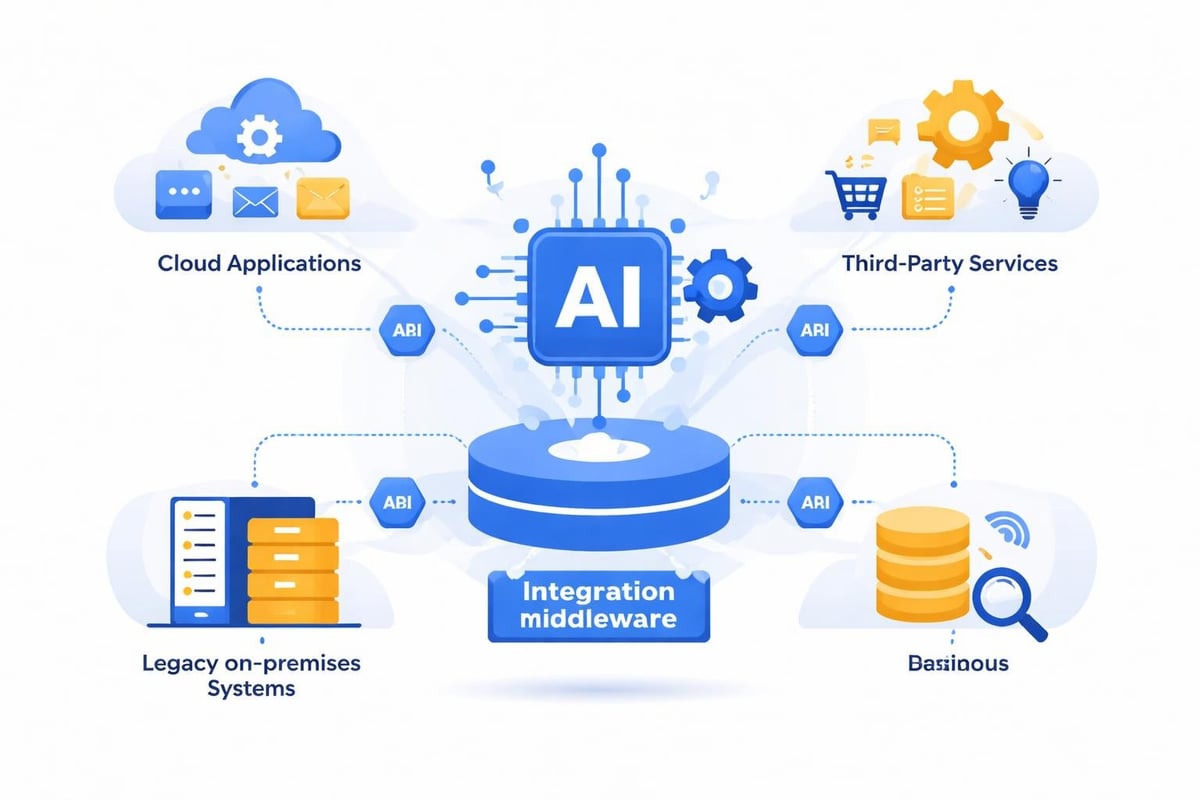
Enterprise environments rarely permit complete system replacement. AI automation must coexist with legacy applications, established databases, and diverse third-party tools. This integration complexity represents one of the primary implementation challenges.
Microsoft Power Automate's enterprise intelligent automation capabilities demonstrate how modern platforms bridge legacy and modern systems through flexible connectors. The key lies in API-first architectures that treat integration as a core capability rather than an afterthought.
API-Driven Automation Architecture
Successful enterprise AI automation relies on robust API strategies:
- RESTful APIs for standard system-to-system communication
- Webhooks enabling real-time event-driven automation
- GraphQL endpoints for efficient data querying across systems
- Message queues handling asynchronous processing and load balancing
- Authentication layers securing automated access while enabling functionality
No-code platforms excel in this environment because they provide pre-built connectors to common enterprise systems while supporting custom API integrations. This means AI software development projects can integrate with existing infrastructure without extensive custom coding.
Handling System Heterogeneity
Enterprise technology stacks typically include applications built across different eras with varying architectural approaches. AI automation layers must accommodate this diversity.
Cloud-native SaaS applications typically offer modern APIs with excellent documentation. On-premise legacy systems may require middleware or integration platforms to expose functionality. Desktop applications might need robotic process automation handling user interface interactions when APIs don't exist.
Security and Compliance in Automated Systems
AI automation for enterprise apps introduces new considerations for security architecture and regulatory compliance. Automated systems access sensitive data, make consequential decisions, and operate continuously without human supervision. This requires robust safeguards.
Access Control and Audit Trails
Automated processes need appropriate system permissions while maintaining security principles:
- Service accounts with minimal necessary privileges for automated tasks
- Role-based access control ensuring AI actions respect organizational hierarchies
- Complete audit logging capturing every automated decision and action
- Anomaly detection identifying unusual automated behavior patterns
- Human review checkpoints for high-stakes decisions or edge cases
These controls ensure automation enhances rather than compromises security posture. Modern platforms handling AI tools for development include these capabilities as standard features rather than requiring custom implementation.
Regulatory and Compliance Considerations
Industries like healthcare, finance, and government face stringent compliance requirements affecting automation implementation. AI systems must:
Maintain data privacy. Automated processes handling personally identifiable information need encryption, access controls, and retention policies matching regulatory requirements. Systems must support data localization where regulations require it.
Provide explainability. Many regulations require organizations to explain automated decisions, particularly those affecting individuals. AI systems need logging that captures decision factors and reasoning, not just outcomes.
Enable human oversight. Regulations increasingly require human involvement in consequential automated decisions. Systems should flag such situations and route them appropriately while documenting the review process.
Research on AI-native frameworks for ERP automation demonstrates compliance-aware architecture patterns that maintain regulatory requirements while achieving automation benefits.
The Role of AIOps in Enterprise Operations
AIOps represents a specialized application of ai automation for enterprise apps focused specifically on IT operations. As enterprise application portfolios grow more complex, manual operations management becomes impossible.
AIOps systems analyze logs, metrics, and events across entire technology stacks to detect issues, predict failures, and automate remediation. This proactive approach prevents outages rather than simply responding to them.
Operational Intelligence Capabilities
Modern AIOps platforms provide several critical capabilities for enterprise environments:
- Anomaly detection identifying unusual patterns across metrics, logs, and events
- Root cause analysis correlating symptoms across systems to identify underlying issues
- Predictive maintenance forecasting component failures before they occur
- Automated remediation executing standard fixes without human intervention
- Capacity planning predicting resource needs based on usage trends
These capabilities transform IT operations from reactive firefighting to proactive management. Organizations report 60-80% reductions in mean time to resolution when implementing comprehensive AIOps strategies.
Self-Healing Systems
The ultimate expression of operational automation involves systems that detect and correct problems autonomously. Self-healing architectures combine monitoring, diagnostics, and remediation into closed loops.
When a web server becomes unresponsive, the system automatically routes traffic away, investigates the cause, attempts standard fixes, and escalates to humans only if automated remediation fails. This approach dramatically improves application reliability while reducing operational burden.
Emerging Trends in Enterprise AI Automation
The evolution of ai automation for enterprise apps continues accelerating with several trends gaining momentum in 2026. Agentic commerce demonstrates AI agents autonomously executing purchasing decisions, pointing toward broader autonomous capabilities in enterprise contexts.
Autonomous Process Management
Next-generation systems move beyond automating predefined workflows toward autonomous process optimization. AI agents analyze business objectives, identify inefficiencies, propose process changes, and implement improvements with minimal human direction.
This represents a fundamental shift from automation-as-configuration to automation-as-collaboration. Businesses define goals and constraints, then AI systems determine optimal approaches for achieving them. Early implementations focus on well-bounded domains like inventory management or scheduling before expanding to more complex processes.
Multimodal AI Integration
Enterprise applications increasingly handle diverse data types: text documents, images, videos, audio recordings, and sensor data. Multimodal AI systems process all these formats within unified workflows, enabling richer automation scenarios.
Consider facilities management applications that analyze video feeds to detect maintenance needs, process verbal work orders, review equipment manuals, and schedule repairs. This comprehensive data processing creates possibilities impossible with text-only automation.
Collaborative AI Agents
Rather than single AI systems handling isolated tasks, emerging architectures deploy multiple specialized agents that collaborate on complex objectives. One agent might handle customer communication while another manages inventory and a third coordinates logistics, all working together to fulfill orders.
This agent-based approach mirrors human organizational structures, making systems easier to understand and manage. It also enables more sophisticated automation by combining specialized capabilities rather than requiring single monolithic systems.
Cost Economics of AI Automation
Understanding the financial implications of ai automation for enterprise apps requires analysis beyond initial implementation costs. Total cost of ownership includes development, infrastructure, maintenance, and organizational change management.
Implementation Investment Breakdown
Typical enterprise AI automation projects involve several cost categories:
| Cost Component | Traditional Development | No-Code Approach | Difference |
|---|---|---|---|
| Initial development | $150,000-$500,000 | $30,000-$100,000 | 70-80% lower |
| Infrastructure setup | $20,000-$80,000 | $5,000-$15,000 | 60-75% lower |
| Annual maintenance | 15-20% of dev cost | 10-15% of dev cost | Lower % and base |
| Update/enhancement cycles | $50,000-$150,000 | $10,000-$30,000 | 70-80% lower |
These differences explain why many enterprises increasingly favor no-code platforms for automation initiatives. Lower costs enable broader automation adoption and faster ROI achievement.
Return on Investment Timelines
Most enterprise AI automation projects achieve positive ROI within 6-18 months depending on scope and implementation approach. Key factors influencing ROI timeline include:
Process volume. High-frequency processes generate faster returns because automation benefits compound with each execution. A process running 100 times daily creates 10x more value than one running 10 times daily.
Labor cost savings. Processes requiring expensive specialized skills (legal review, technical analysis) generate larger per-execution savings than routine administrative tasks.
Error reduction value. Processes where mistakes create significant costs (regulatory violations, customer churn, inventory waste) justify automation even without major time savings.
Scalability requirements. Organizations expecting rapid growth find automation ROI improves dramatically as volume increases without proportional staffing needs.
Building Organizational AI Automation Capabilities
Technology alone doesn't ensure successful ai automation for enterprise apps. Organizations need complementary capabilities in process analysis, change management, and continuous improvement.
Skills and Team Structure
Effective enterprise automation requires diverse skill sets working together:
Business process analysts who understand current workflows, identify automation opportunities, and define requirements. These individuals bridge business needs and technical implementation.
No-code developers who configure automation platforms, integrate systems, and implement business logic. Modern no-code tools enable rapid development without traditional programming expertise.
Data specialists ensuring AI systems access quality data in appropriate formats. This includes data engineering, governance, and analytics capabilities.
Change management professionals who guide organizational adoption, training, and process redesign. Technical success means nothing without user adoption.
Many enterprises build centers of excellence that combine these skills and support automation initiatives across business units. This centralized expertise prevents redundant efforts while spreading best practices.
Continuous Improvement Methodology
AI automation should evolve continuously rather than remaining static after initial deployment. Implement regular review cycles examining:
- Performance against established metrics (efficiency, quality, user satisfaction)
- New automation opportunities identified through user feedback or process changes
- Model accuracy and drift for AI components requiring retraining
- Integration issues as connected systems evolve
- Emerging capabilities from platform providers and technology advances
This continuous improvement approach treats automation as an ongoing program rather than discrete projects. Organizations maintaining active improvement cycles report 2-3x greater long-term value compared to deploy-and-maintain approaches.
When building these capabilities, partnering with experienced agencies can accelerate progress while developing internal expertise. Specialists who work across multiple implementations bring proven patterns and avoid common pitfalls.
AI automation for enterprise apps transforms how organizations build, deploy, and operate business-critical software while creating new possibilities for efficiency, scalability, and innovation. The convergence of mature AI capabilities with accessible no-code development platforms means these benefits are now available to enterprises of all sizes, not just technology giants with massive R&D budgets. Whether you're looking to automate a single high-impact process or reimagine your entire application portfolio, Big House Technologies combines deep expertise in no-code platforms with AI integration capabilities to deliver scalable automation solutions that drive measurable business results. Our comprehensive approach from scoping through deployment ensures your automation initiatives deliver on time, within budget, and with the flexibility to evolve as your needs change.

About Big House
Big House is committed to 1) developing robust internal tools for enterprises, and 2) crafting minimum viable products (MVPs) that help startups and entrepreneurs bring their visions to life.
If you'd like to explore how we can build technology for you, get in touch. We'd be excited to discuss what you have in mind.
Other Articles
Discover 9 essential apps like Chat GPT to try in 2025 Compare features pricing and benefits to find the best AI chatbot for productivity creativity and research
Learn how to hire no code product teams in 2026 with this step by step guide covering roles skills hiring best practices and agency selection for success
We ran an experiment comparing Bubble and Webflow by building identical websites to test SEO and performance. Read on to explore the results and determine which platform offers better features for your business.