
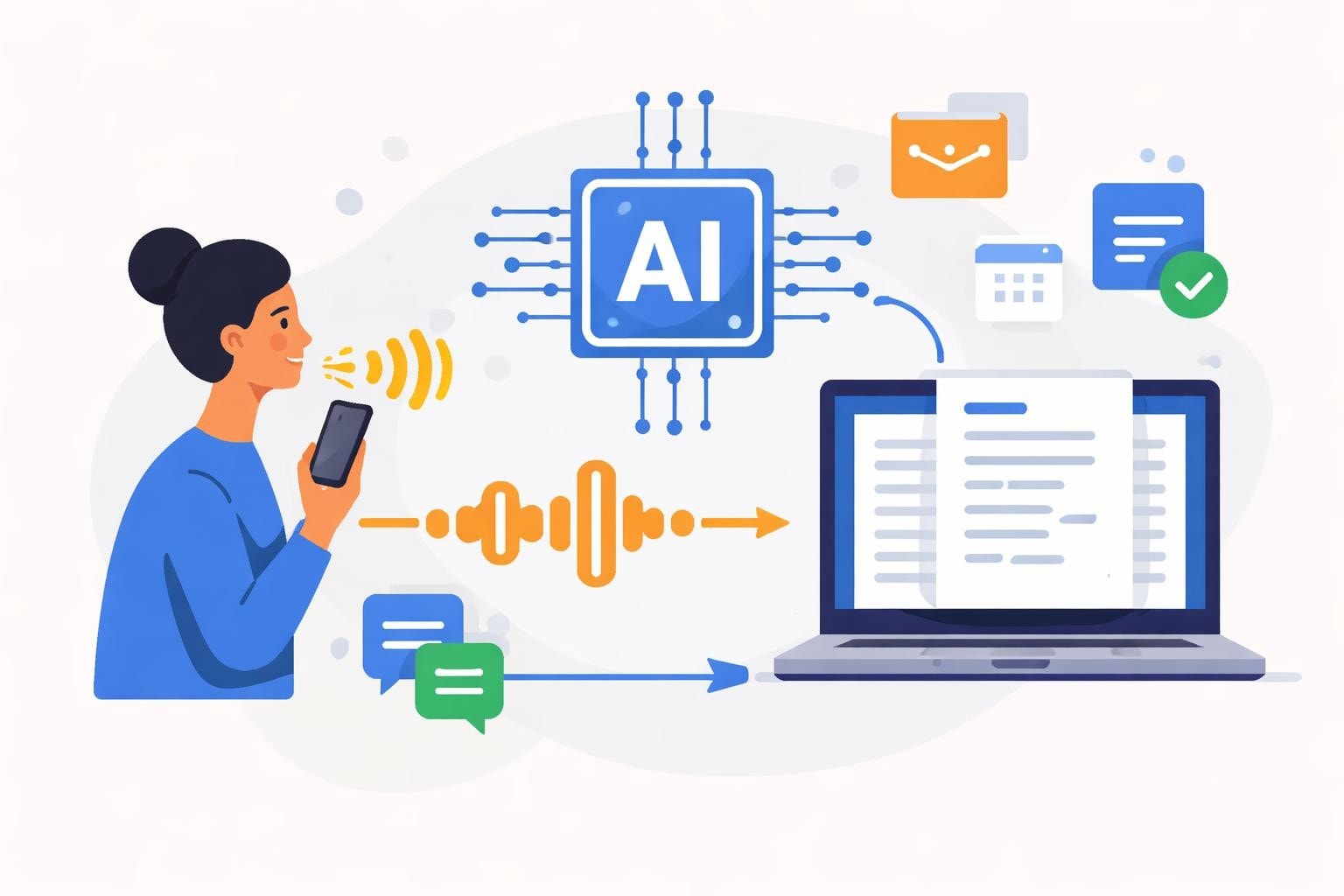
Voice to text AI has emerged as one of the most transformative technologies reshaping how businesses communicate, document information, and build user-friendly applications. This sophisticated technology converts spoken language into written text with remarkable accuracy, enabling hands-free productivity, improved accessibility, and seamless integration into modern software solutions. For enterprises and startups leveraging no-code platforms, understanding voice to text AI capabilities opens new possibilities for creating intuitive, voice-enabled applications without extensive development resources.
Understanding Voice to Text AI Technology
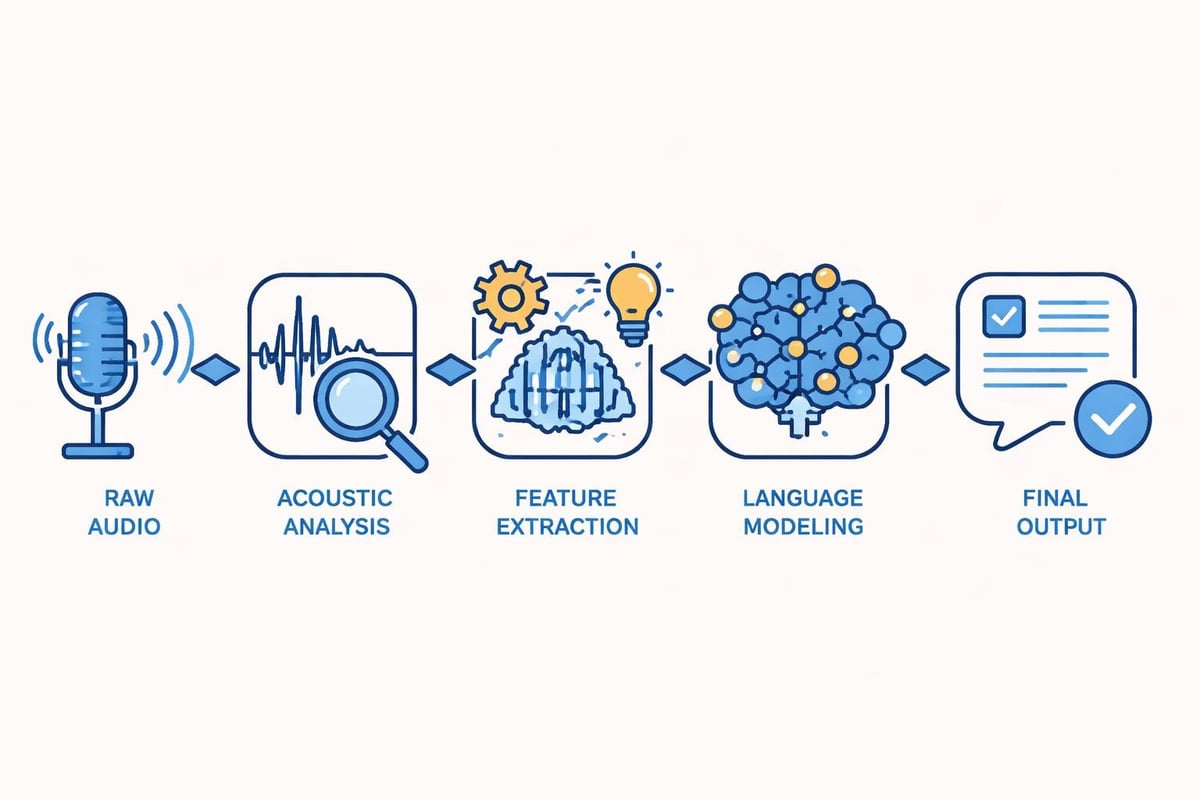
Voice to text AI represents a convergence of multiple advanced technologies working in harmony. At its core, speech-to-text technology captures audio input, processes acoustic features, and converts speech patterns into readable text through sophisticated algorithms.
The technology relies on three fundamental components that work together seamlessly:
- Automatic Speech Recognition (ASR) analyzes audio signals and identifies phonetic patterns
- Natural Language Processing (NLP) interprets context, grammar, and semantic meaning
- Machine Learning (ML) continuously improves accuracy based on training data and user corrections
Modern voice to text AI systems achieve accuracy rates exceeding 95% in optimal conditions, a remarkable improvement from earlier iterations that struggled with basic transcription tasks. This advancement stems from deep learning models trained on millions of hours of speech data across diverse languages, accents, and speaking styles.
The Evolution of Speech Recognition
Speech recognition technology has evolved dramatically over the past decade. Early systems required extensive training periods where users had to "teach" the software their voice patterns. Today's voice to text AI works immediately, adapting to individual speech characteristics in real-time.
The development of neural networks and transformer models has revolutionized transcription quality. Systems like Whisper, developed by OpenAI, demonstrate how modern architectures handle multiple languages and challenging audio conditions with unprecedented accuracy.
Business Applications Transforming Industries
Voice to text AI delivers tangible value across numerous business sectors. AI voice-to-text transcription is revolutionizing communication by making documentation faster, more accessible, and increasingly accurate.
Healthcare Documentation
Medical professionals spend countless hours on administrative tasks. Voice to text AI enables doctors to dictate patient notes, prescriptions, and medical reports while maintaining focus on patient care.
Key healthcare benefits include:
- Real-time clinical documentation during patient consultations
- Reduced administrative burden on medical staff
- Improved accuracy in medical record keeping
- Enhanced patient engagement through immediate documentation
Healthcare applications demand exceptional accuracy because errors can have serious consequences. Modern systems understand medical terminology, drug names, and anatomical references with specialized training.
Legal and Compliance
The legal profession requires meticulous documentation where every word matters. Understanding AI voice-to-text quality becomes critical in legal proceedings where transcripts serve as official records.
Law firms leverage voice to text AI for depositions, court proceedings, client meetings, and contract review. The technology provides searchable, timestamped transcripts that legal professionals can reference instantly.
| Legal Use Case | Primary Benefit | Accuracy Requirement |
|---|---|---|
| Court Proceedings | Official Record | 99%+ |
| Client Consultations | Documentation | 95%+ |
| Contract Dictation | Efficiency | 98%+ |
| Case Notes | Reference | 90%+ |
Media and Content Creation
Content creators, journalists, and podcasters rely on voice to text AI to transform audio content into written articles, show notes, and searchable transcripts. This application extends content reach and improves SEO performance.
Broadcasting organizations use real-time transcription for live captioning, making content accessible to hearing-impaired audiences and enabling better content indexing.
Integration with No-Code Development
Voice to text AI integration within no-code platforms democratizes advanced functionality for businesses without extensive technical resources. AI-powered no-code development tools enable rapid deployment of voice-enabled features that would traditionally require months of custom development.
No-code platforms now offer pre-built voice transcription components that developers can configure through visual interfaces. This capability allows startups and enterprises to incorporate sophisticated voice features into their applications quickly.
Building Voice-Enabled Applications
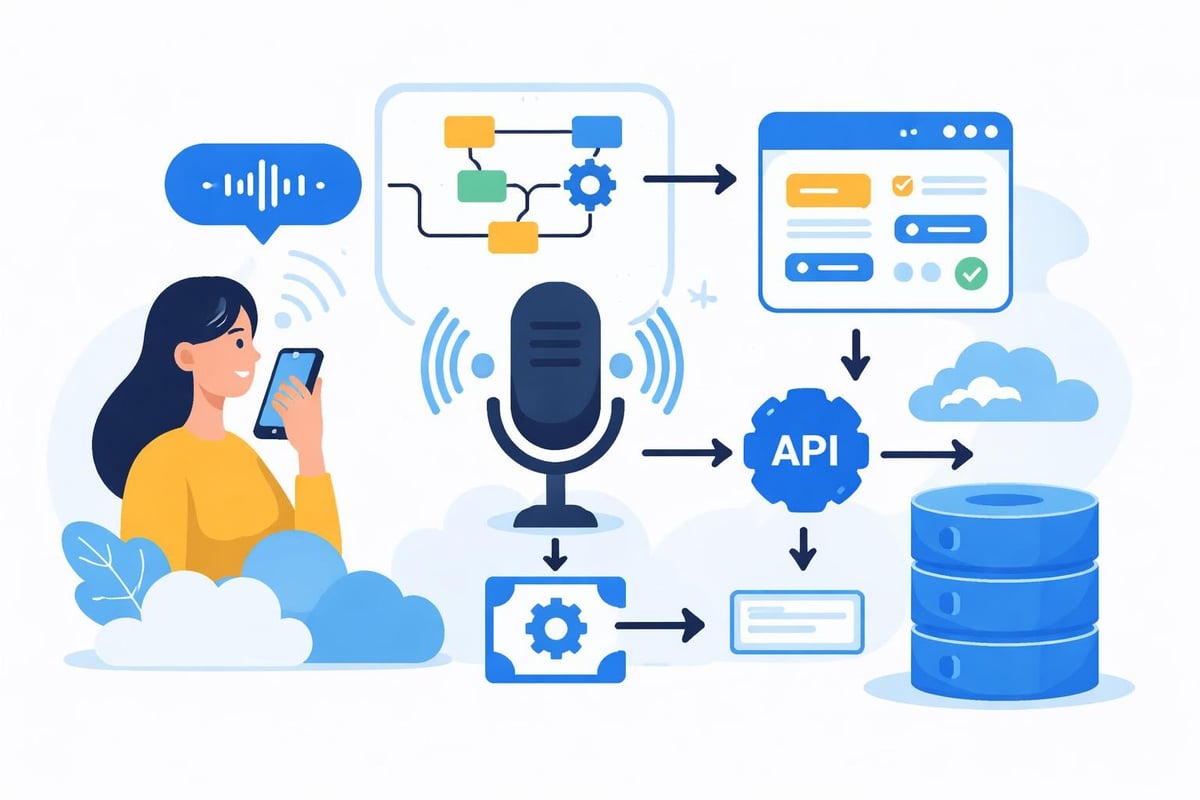
Creating voice-enabled applications through no-code platforms involves several straightforward steps:
- Select a voice to text AI provider with API support compatible with your platform
- Configure audio input sources including microphone access and file uploads
- Map transcription outputs to database fields or application workflows
- Implement error handling for low-quality audio or recognition failures
- Test across devices to ensure consistent performance on different hardware
Platforms like Bubble enable developers to connect voice transcription APIs through plugins and API connectors, creating seamless voice-to-text experiences without writing code. This approach significantly reduces development time and costs while maintaining professional-grade functionality.
Technical Considerations for Implementation
When implementing voice to text AI in no-code applications, several technical factors influence success:
Audio Quality Management:
- Ensure minimum sample rates (16kHz recommended)
- Implement noise reduction where possible
- Provide clear user guidance on microphone positioning
- Consider browser compatibility for web applications
Data Privacy and Security:
- Choose providers with robust encryption standards
- Understand data retention policies
- Implement user consent mechanisms
- Consider GDPR and compliance requirements
Performance Optimization:
- Balance real-time versus batch processing needs
- Optimize for mobile bandwidth constraints
- Implement progressive enhancement strategies
- Cache common phrases for faster processing
Industry-Specific Applications and Use Cases
Voice to text AI applications span virtually every industry, each with unique requirements and benefits. Understanding these specialized implementations helps businesses identify opportunities within their operations.
Customer Service and Support
Customer service teams use voice to text AI to transcribe support calls, creating searchable records that improve quality assurance and training programs. Automated transcription enables sentiment analysis and keyword detection for better customer insights.
Support ticket systems integrated with voice transcription allow customers to describe issues verbally rather than typing detailed explanations, reducing friction and improving resolution times.
Education and E-Learning
Educational institutions leverage voice to text AI for lecture transcription, making course content accessible to students with disabilities and creating study materials automatically. Language learning applications use the technology to provide pronunciation feedback and conversation practice.
Real-time captioning in virtual classrooms ensures all students can follow along regardless of audio quality or hearing ability, promoting inclusive learning environments.
Sales and CRM Integration
Sales teams benefit from automatic meeting transcription that captures client conversations, action items, and commitments without manual note-taking. When integrated with CRM systems, voice to text AI populates contact records, updates deal stages, and triggers follow-up workflows based on conversation content.
This integration allows sales representatives to focus entirely on relationship building while ensuring comprehensive documentation of every interaction.
Quality Metrics and Accuracy Factors
Voice to text AI performance varies based on multiple factors that businesses must consider when evaluating solutions. Understanding these metrics helps set realistic expectations and choose appropriate providers.
| Quality Factor | Impact on Accuracy | Mitigation Strategy |
|---|---|---|
| Background Noise | High (-20% to -40%) | Use noise cancellation, controlled environments |
| Accent Variation | Medium (-10% to -20%) | Select models trained on diverse datasets |
| Technical Jargon | Medium (-15% to -25%) | Choose industry-specific or customizable models |
| Audio Quality | High (-25% to -50%) | Ensure proper microphone equipment, encoding |
| Speaking Pace | Low (-5% to -10%) | Provide user guidance on optimal speaking speed |
Modern voice to text AI systems adapt to individual speakers over time, learning vocabulary preferences and speech patterns. This personalization significantly improves accuracy for regular users, making the technology increasingly valuable with continued use.
Measuring Transcription Quality
Professional applications require systematic quality measurement. Word Error Rate (WER) serves as the industry standard metric, calculating the percentage of words incorrectly transcribed, substituted, or omitted.
Premium voice to text AI solutions achieve WER below 5% in controlled conditions, though real-world performance typically ranges between 8% and 15% depending on use case complexity.
Cost Efficiency and ROI Considerations
Implementing voice to text AI delivers measurable returns through time savings, improved accuracy, and enhanced productivity. Businesses transitioning to MVP software development can incorporate voice features early to differentiate their products and gather valuable user feedback.
Financial benefits include:
- Reduced transcription costs compared to manual services
- Decreased documentation time for professionals
- Lower training expenses through automated materials creation
- Improved compliance reducing legal exposure costs
Most voice to text AI providers offer tiered pricing based on usage volume, allowing businesses to scale costs proportionally with growth. This flexibility makes the technology accessible to startups while remaining cost-effective for enterprises processing millions of minutes monthly.
Calculating Return on Investment
Organizations should consider both direct and indirect benefits when calculating voice to text AI ROI. Direct savings come from replacing manual transcription services or reducing staff time spent on documentation. Indirect benefits include improved data accessibility, enhanced searchability, and better compliance tracking.
A typical enterprise deployment might save 10-15 hours weekly per knowledge worker, translating to significant annual cost reductions and productivity gains.
Privacy, Security, and Compliance
Voice data contains sensitive information requiring robust security measures. Enterprises must evaluate provider security practices, data handling policies, and compliance certifications before deployment.
Critical security considerations:
- Encryption standards for data in transit and at rest
- Data residency options meeting geographic compliance requirements
- Access controls limiting who can view transcription data
- Audit logging tracking all data access and modifications
- Retention policies defining how long voice data is stored
Healthcare and financial services face particularly stringent requirements. HIPAA compliance for medical applications and PCI-DSS standards for payment-related voice interactions demand providers with specific certifications and security controls.

Future Trends and Emerging Capabilities
Voice to text AI continues evolving rapidly with new capabilities emerging regularly. Modern speech recognition technology now incorporates emotion detection, speaker identification, and real-time translation alongside basic transcription.
Multilingual and Real-Time Translation
Next-generation systems transcribe and translate simultaneously, breaking down language barriers in global business communications. This capability enables international collaboration where participants speak different languages while receiving transcripts in their preferred language.
Real-time translation accuracy has improved dramatically, approaching human interpreter quality for common language pairs. Businesses expanding internationally leverage these capabilities to reduce communication costs while maintaining relationship quality.
Emotion and Sentiment Analysis
Advanced voice to text AI platforms now detect emotional tone, stress levels, and sentiment alongside transcription. Customer service applications use these insights to identify dissatisfied customers, flag escalation needs, and provide coaching feedback to representatives.
Sales teams benefit from sentiment tracking during negotiations, helping identify concerns and opportunities that might not be explicitly stated.
Custom Vocabulary and Domain Adaptation
Modern platforms allow businesses to train models on industry-specific terminology, product names, and internal jargon. This customization dramatically improves accuracy for specialized applications where standard models struggle with technical language.
Companies working with unique vocabularies can achieve accuracy levels comparable to general speech in standard applications, making voice to text AI viable for previously challenging use cases.
Selecting the Right Voice to Text AI Solution
Choosing appropriate voice to text AI technology requires evaluating multiple factors aligned with specific business needs. Different providers excel in different areas, making careful selection critical for successful implementation.
Evaluation Criteria
Technical Requirements:
- Supported languages and dialects
- Real-time versus batch processing capabilities
- API availability and documentation quality
- Integration options with existing systems
- Scalability limits and performance guarantees
Business Considerations:
- Pricing structure and cost predictability
- Service level agreements and uptime guarantees
- Support availability and response times
- Vendor stability and product roadmap
- Data ownership and portability options
Organizations should conduct proof-of-concept testing with actual use case data before committing to a provider. Testing reveals real-world performance characteristics that specifications alone cannot predict.
For businesses exploring AI software development, partnering with experienced agencies that understand both voice technology and no-code platforms accelerates deployment while avoiding common implementation pitfalls.
Accessibility and Inclusive Design
Voice to text AI plays a crucial role in creating accessible digital experiences. Applications incorporating voice input accommodate users with mobility impairments, visual disabilities, or conditions making typing difficult.
Accessibility benefits extend to:
- Users with dyslexia who find speaking easier than writing
- Professionals multitasking who need hands-free input
- Elderly users less comfortable with keyboards
- Non-native speakers who speak more fluently than they type
Designing voice-first interfaces requires understanding how users interact verbally versus visually. Clear voice prompts, confirmation dialogs, and error correction mechanisms create smooth experiences that don't frustrate users when recognition inevitably fails occasionally.
Building accessible applications aligns with legal requirements in many jurisdictions while expanding potential user bases significantly. Companies like Kollektif® can help design voice-enabled brand experiences that feel natural and premium while maintaining accessibility standards.
Performance Optimization Strategies
Maximizing voice to text AI performance requires attention to both technical implementation and user experience design. Organizations achieving highest accuracy rates combine quality technology with thoughtful deployment strategies.
Audio Quality Enhancement
Superior audio input directly correlates with transcription accuracy. Businesses should invest in quality microphones for professional applications and provide guidance for consumer applications.
Best practices include:
- Using directional microphones to reduce background noise
- Implementing acoustic treatments in recording environments
- Selecting appropriate sample rates and encoding formats
- Testing audio quality before processing transcription
- Providing real-time audio level monitoring for users
Context and Language Models
Providing contextual information improves accuracy significantly. Systems understanding the application domain, expected vocabulary, and conversation context make more accurate predictions when multiple interpretations exist.
Custom language models trained on domain-specific text improve recognition of industry terminology, product names, and internal jargon that general-purpose models struggle with.
Marketing and SEO Benefits
Voice to text AI creates new content opportunities that enhance digital marketing efforts. Transcribing podcasts, webinars, and video content generates searchable text that improves SEO performance while making content more accessible.
Search engines cannot index audio content directly, making transcripts essential for discoverability. Companies like Get To Page One Ltd leverage transcription services to optimize multimedia content for search visibility.
Repurposing voice content into blog posts, social media updates, and email newsletters maximizes content investment while reaching audiences preferring different formats. This multi-format approach increases content reach without proportionally increasing creation costs.
Voice Search Optimization
As voice search adoption grows, understanding natural language patterns becomes critical for SEO success. Voice queries differ significantly from typed searches, typically using longer, more conversational phrases.
Optimizing content for voice search requires incorporating question-based keywords, natural language patterns, and featured snippet opportunities that voice assistants prioritize.
Voice to text AI has matured into an essential technology for modern businesses, offering unprecedented opportunities to improve productivity, accessibility, and user experiences. The convergence of sophisticated AI models with accessible no-code platforms democratizes these capabilities, enabling organizations of all sizes to incorporate voice features without extensive development resources. Whether you're building a new application or enhancing existing workflows, Big House Technologies specializes in integrating voice to text AI and other advanced features into no-code solutions that scale with your business, delivering high-quality products efficiently and cost-effectively.

About Big House
Big House is committed to 1) developing robust internal tools for enterprises, and 2) crafting minimum viable products (MVPs) that help startups and entrepreneurs bring their visions to life.
If you'd like to explore how we can build technology for you, get in touch. We'd be excited to discuss what you have in mind.
Other Articles
Discover how Prezi AI stacks up against traditional presentation tools in 2025 Compare features, pricing, design, and user feedback to choose your best fit
Discover the top 7 enterprise integration platforms no code for 2026 Compare features pricing and benefits to streamline automation and boost business agility
Discover the best AI product development tools for startups in 2026. Learn how to build faster, smarter, and more cost-effectively.