
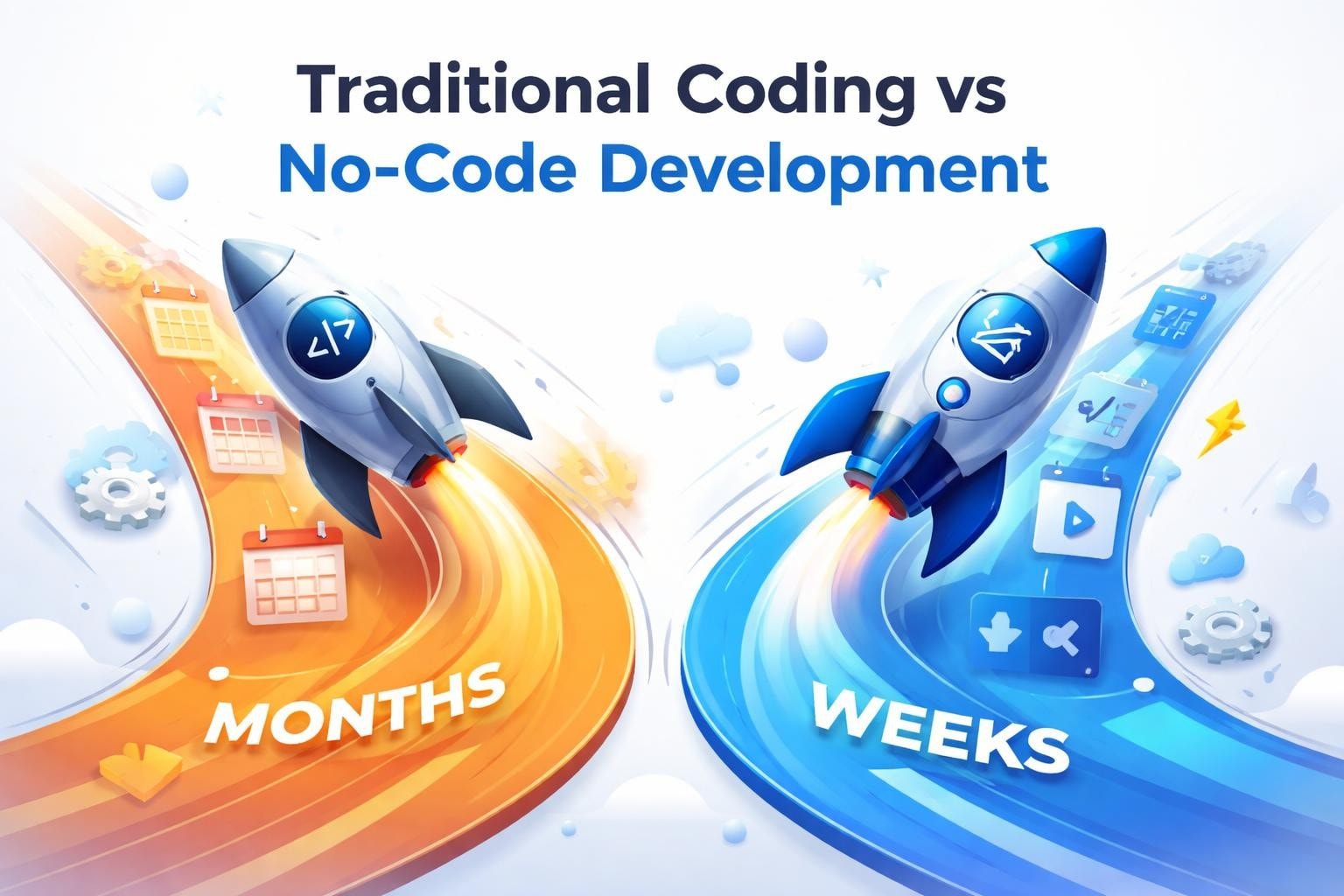
Speed defines startup success in 2026. While competitors spend months on traditional development, smart founders leverage no-code platforms to ship products in weeks or even days. The fastest no-code platforms for startups combine rapid deployment capabilities with enterprise-grade scalability, enabling lean teams to compete against well-funded rivals. This transformation isn't just about eliminating code; it's about compressing the entire development lifecycle from idea to market-ready product.
Speed Metrics That Matter for Startup Platforms
When evaluating the fastest no-code platforms for startups, development velocity extends beyond simple build time. Three critical metrics determine whether a platform truly accelerates your launch:
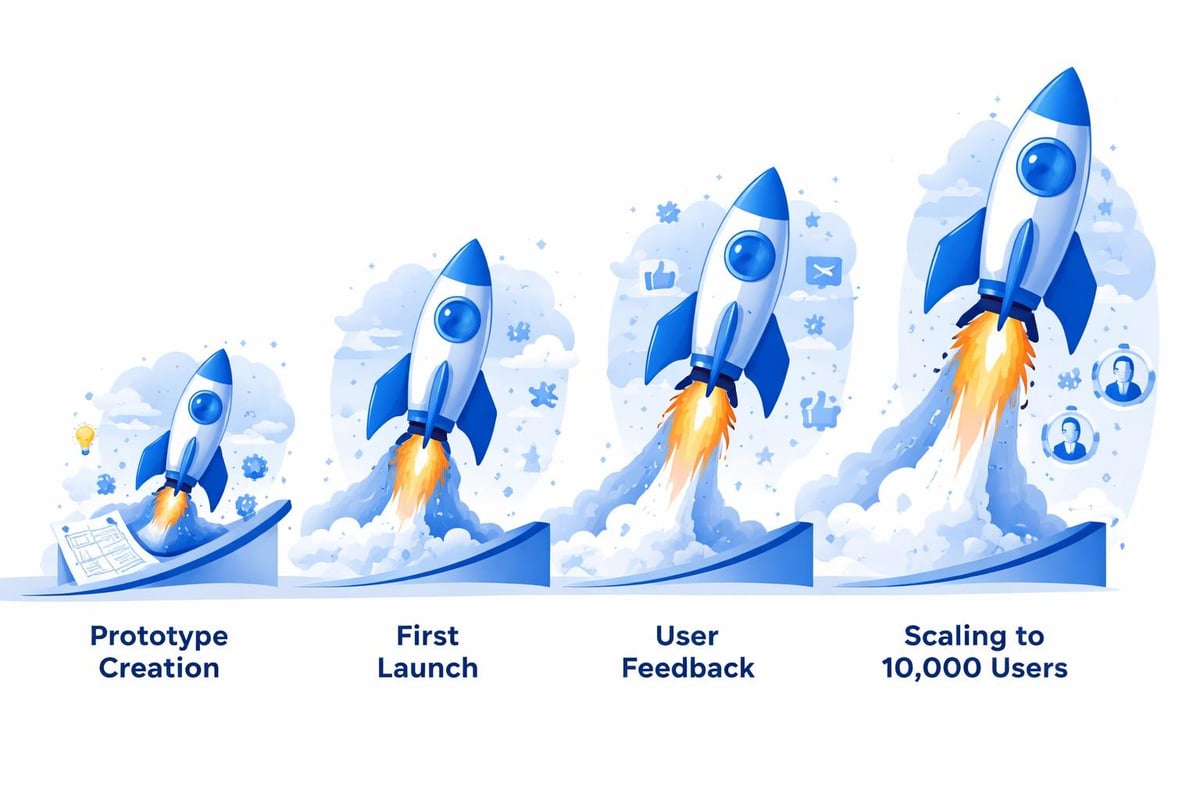
Time-to-first-deployment measures how quickly you can push a functional prototype to production. The best platforms enable initial deployment within 24-48 hours, not weeks. Iteration speed tracks how rapidly you can implement user feedback and push updates. Modern no-code platforms excel at continuous deployment, allowing multiple daily iterations without downtime.
Deployment Frequency and Scaling Response
Scaling responsiveness quantifies how fast your infrastructure adapts to traffic spikes. Traditional applications require manual configuration and DevOps intervention. Advanced no-code platforms automatically scale resources based on demand, eliminating bottlenecks during viral growth.
| Platform Type | Time to Prototype | First Deployment | Iteration Cycle | Auto-Scaling |
|---|---|---|---|---|
| Traditional Code | 2-4 weeks | 6-12 weeks | 1-2 weeks | Manual |
| Low-Code | 1-2 weeks | 3-6 weeks | 3-5 days | Semi-auto |
| No-Code (Standard) | 2-5 days | 1-2 weeks | 1-2 days | Automatic |
| AI-Powered No-Code | 4-24 hours | 2-3 days | Hours | Automatic |
The emergence of AI-powered development tools has revolutionized these timelines. Platforms leveraging large language models now generate functional applications from natural language descriptions, compressing what previously took days into hours.
Top-Tier Platforms Ranked by Deployment Speed
Bubble dominates the no-code landscape for comprehensive web applications. This platform enables startups to build complex, database-driven applications without traditional coding constraints. Development teams can create fully functional MVPs within one to two weeks, depending on feature complexity.
Visual Development Powerhouses
Bubble's architecture supports sophisticated workflows, API integrations, and custom logic through visual programming. The learning curve requires investment, but experienced Bubble developers can prototype features in hours rather than days. The platform's responsive engine automatically optimizes for mobile and desktop, eliminating duplicate development efforts.
Webflow specializes in content-heavy websites and marketing platforms. For startups prioritizing design aesthetics and SEO optimization, Webflow delivers production-ready sites within days. The platform's CMS capabilities rival traditional solutions while maintaining visual control over every element.
- Direct publishing to custom domains within minutes
- Built-in SEO optimization and page speed enhancement
- Integrated hosting with global CDN distribution
- Real-time collaboration for distributed teams
Flutterflow accelerates native mobile app development through visual design and automated code generation. Unlike pure no-code platforms, Flutterflow produces actual Flutter code, enabling custom modifications when necessary. This hybrid approach positions it among the fastest no-code platforms for startups targeting mobile-first audiences.
AI-Enhanced Development Platforms
Lovable represents the cutting edge of AI-assisted development. By combining natural language processing with visual workflows, the platform transforms conversational descriptions into functional applications. Research into LLM-powered development demonstrates how these approaches can reduce development time by 60-80% compared to traditional no-code platforms.
The platform's intelligent interpretation eliminates repetitive configuration tasks. Instead of manually defining database schemas, workflows, and UI components, developers describe desired functionality in plain language. The system generates optimized implementations, which teams can refine through iterative prompts.
Key acceleration features:
- Natural language to functional code transformation
- Automatic database schema generation and optimization
- Intelligent UI component suggestions based on use case
- Built-in testing and debugging through conversational interface
- One-click deployment to production environments

Database and Backend Infrastructure Speed
Backend complexity traditionally slows startup development. Database design, API creation, authentication systems, and server management consume weeks of technical work. Modern no-code platforms abstract these challenges, but speed varies dramatically across solutions.
Airtable and its competitors excel at rapid database prototyping. Within hours, teams can structure complex relational databases, create automated workflows, and generate shareable interfaces. The platform's spreadsheet-like interface reduces the learning curve while maintaining powerful database functionality.
Backend-as-a-Service Integration
Xano provides visual backend development with production-grade performance. Startups can build secure APIs, implement complex business logic, and manage scalable databases through an intuitive interface. The platform generates optimized backend code that handles enterprise-level traffic without modification.
| Backend Platform | Setup Time | API Creation | Database Design | Auth Implementation |
|---|---|---|---|---|
| Xano | 2-4 hours | 30 min/endpoint | 1-2 hours | Pre-built |
| Supabase | 1-2 hours | 15 min/endpoint | 30-60 min | Pre-built |
| Firebase | 3-6 hours | 1 hour/endpoint | 2-3 hours | Pre-built |
| Custom Code | 2-3 weeks | 2-4 hours/endpoint | 1-2 weeks | 3-5 days |
Supabase combines PostgreSQL databases with instant APIs and real-time subscriptions. The platform's speed advantage comes from auto-generated APIs based on database structure. Adding a new table automatically creates corresponding CRUD endpoints, eliminating manual API development.
Authentication and security typically require extensive development time. Leading platforms include pre-built solutions supporting social logins, multi-factor authentication, and role-based access control. Implementation requires configuration rather than coding, reducing security setup from days to hours.
Workflow Automation and Integration Velocity
Integration capabilities determine how quickly startups can connect disparate systems and automate operations. Workflow automation platforms like Zapier and Make enable non-technical teams to build sophisticated automation in minutes.
These platforms connect thousands of applications through pre-built integrations. Creating a workflow that synchronizes data between CRM, email marketing, and accounting systems requires selecting apps, mapping fields, and defining trigger conditions. The entire process takes 15-30 minutes versus weeks of custom integration development.
Advanced Automation Architectures
Make (formerly Integromat) provides visual automation with conditional logic, error handling, and data transformation. The platform's router and filter modules enable complex decision trees within workflows. Startups can implement multi-step processes that previously required custom backend development.
n8n offers self-hosted automation with unlimited workflow executions. For startups with specific compliance or data residency requirements, n8n combines the speed of visual automation with complete infrastructure control. The platform's node-based interface supports custom JavaScript when pre-built integrations don't suffice.
Modern automation extends beyond simple triggers and actions. Advanced no-code workflow builders now incorporate natural language inputs, allowing users to describe desired automation in conversational terms. The system interprets intent and generates optimized workflows automatically.
Mobile App Development Without Traditional Coding
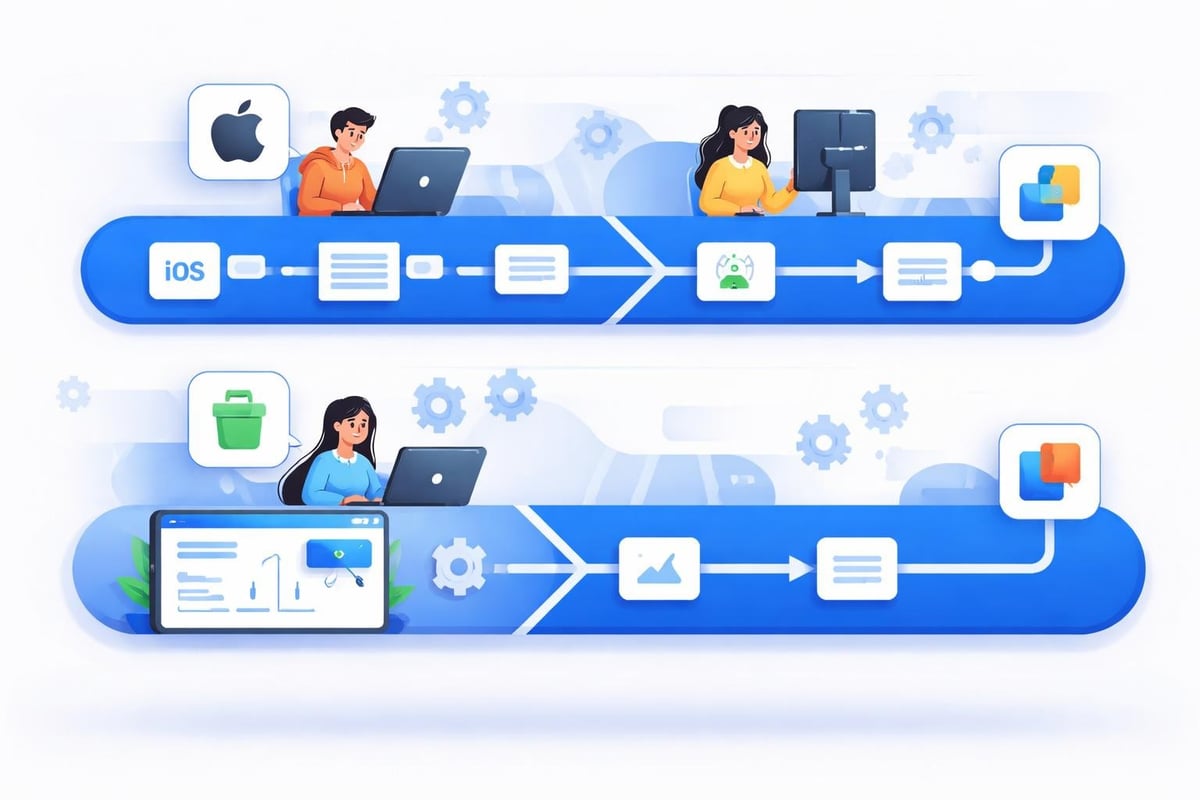
Mobile development traditionally demands platform-specific expertise, separate iOS and Android codebases, and extensive testing across devices. The fastest no-code platforms for startups eliminate these barriers through cross-platform visual development.
Adalo enables mobile app creation through drag-and-drop interfaces and pre-built components. The platform compiles to native iOS and Android applications from a single design. Startups can publish to app stores within days of beginning development, assuming design assets are prepared.
- Pre-designed UI component libraries for rapid assembly
- Built-in database and user management systems
- Native device feature access (camera, GPS, notifications)
- Automatic responsive design for different screen sizes
- Direct submission to Apple and Google app stores
Glide transforms spreadsheets into mobile applications instantly. For data-driven apps requiring frequent updates, Glide's spreadsheet-to-app approach enables real-time synchronization. Content updates in Google Sheets appear immediately in deployed applications without republishing.
Progressive Web App Advantages
PWA builders like Softr create app-like experiences without app store approval delays. These platforms generate responsive web applications that install directly to user home screens. Deployment happens instantly through standard web hosting, eliminating the multi-week app store review process.
The speed advantage compounds during iteration. Updates to PWAs deploy immediately, while native apps require resubmission and approval for each change. For startups in rapid validation phases, this difference can mean daily iterations versus weekly update cycles.
Enterprise Features Without Enterprise Timelines
Scaling startups eventually require enterprise-grade capabilities: advanced permissions, audit logging, compliance certifications, and high-availability infrastructure. Traditional development requires months to implement these features. Modern no-code platforms include enterprise functionality out-of-the-box.
Retool specializes in internal tools requiring sophisticated data operations and permissions. The platform's component library includes advanced tables, charts, and form elements that would take weeks to build custom. Database connections support SQL, GraphQL, and REST APIs through visual query builders.
Role-based access control typically requires extensive backend development. Leading platforms provide granular permission systems through configuration interfaces. Defining user roles, resource access, and conditional visibility takes hours instead of weeks.
Compliance and Security Acceleration
SOC 2 and GDPR compliance demand specific technical implementations and documentation. Platforms maintaining these certifications transfer compliance requirements to their infrastructure. Startups inherit certified security controls rather than building them independently.
Data residency and encryption requirements vary by industry and geography. Enterprise-focused no-code platforms offer regional hosting, encryption at rest, and encrypted data transmission as standard features. Configuring these protections requires selecting options rather than implementing cryptographic systems.
Audit logging tracks all user actions for security and compliance analysis. Traditional implementation involves database design, event tracking, and reporting interfaces. No-code platforms include comprehensive audit systems that administrators activate through dashboard toggles.
Integration Ecosystems and Extension Points
The fastest no-code platforms for startups don't exist in isolation. They integrate with existing tools and extend through plugins, APIs, and custom code when necessary. Integration capabilities determine how quickly startups can connect their no-code applications to existing systems.
Native integrations connect platforms directly without intermediary services. Platforms offering hundreds of pre-built connectors eliminate integration development time entirely. Authentication, data mapping, and error handling happen automatically within tested frameworks.
API-first architectures enable custom integrations when pre-built options don't exist. Visual API builders let non-technical users construct HTTP requests, parse responses, and map data to application fields. What previously required backend developer expertise now requires understanding basic web concepts.
- Webhook receivers enable real-time data flow from external systems
- Custom code blocks allow JavaScript or Python injection for complex logic
- Plugin marketplaces provide community-built extensions for common use cases
- Export capabilities ensure data portability if platform migration becomes necessary
The emergence of AI-powered integration tools further accelerates connection development. Multi-agent systems can understand integration requirements from natural language descriptions and generate appropriate configurations automatically.
Real-World Speed Benchmarks from Successful Startups
Theoretical speed advantages mean nothing without real-world validation. Successful no-code startups demonstrate how platform selection impacts time-to-market and iteration velocity.
Comet, a marketplace platform, launched their MVP in three weeks using Bubble. Traditional development estimates projected four to six months for equivalent functionality. The compressed timeline enabled customer validation and fundraising months ahead of coded alternatives.
Dividend Finance rebuilt their customer portal using Retool, reducing development time from nine months to six weeks. The 85% time reduction freed engineering resources for core product development while delivering improved user experience.
Measuring Development Velocity Improvements
| Success Metric | Traditional Dev | No-Code Platform | Time Savings |
|---|---|---|---|
| MVP Launch | 12-16 weeks | 2-4 weeks | 75-85% |
| Feature Addition | 2-3 weeks | 2-3 days | 80-90% |
| Design Iteration | 3-5 days | 2-4 hours | 90-95% |
| API Integration | 1-2 weeks | 1-3 hours | 95-98% |
| Deployment | 2-4 hours | 5-10 minutes | 95-99% |
These benchmarks assume experienced no-code developers. The learning curve for platforms like Bubble requires one to two weeks for proficiency. However, this investment pays dividends through accelerated development across all subsequent projects.
Platform Selection Framework for Maximum Speed
Choosing among the fastest no-code platforms for startups requires matching platform strengths to specific requirements. No single platform excels across all dimensions. Strategic selection based on product type, team skills, and scaling plans maximizes development velocity.
For content-heavy websites and marketing platforms, Webflow offers unmatched design control and publishing speed. The platform's SEO optimization and hosting performance rival custom-coded solutions while enabling non-technical content updates.
For database-driven web applications, Bubble provides the most comprehensive feature set without coding. The platform supports complex workflows, third-party integrations, and custom business logic through visual programming.
Matching Platform to Product Type
For mobile-first applications, Flutterflow generates truly native apps with smooth performance. The platform's Flutter code output enables app store publication and advanced native features impossible in wrapper-based solutions.
For internal tools and dashboards, Retool dominates through specialized components and database connectivity. The platform's focus on data operations and admin interfaces accelerates enterprise tool development.
For AI-powered applications, Lovable combines conversational development with intelligent feature generation. The platform's understanding of context and intent reduces the specification effort required from product teams.
- Evaluate based on primary use case rather than general capabilities
- Consider team technical skills when assessing learning curve
- Prioritize platforms with strong integration to existing tools
- Review scaling limitations before committing to long-term development
- Test deployment and iteration speed with small proof-of-concept projects
The fastest development platform is the one your team can leverage most effectively. A technically sophisticated platform requiring weeks of learning may ultimately slow development compared to simpler alternatives with immediate productivity.
Acceleration Through Professional No-Code Development
While no-code platforms democratize development, professional expertise compounds speed advantages. Experienced no-code agencies bring platform-specific knowledge, design patterns, and optimization techniques that inexperienced builders lack.
Big House Technologies specializes in rapid application development using Bubble and Lovable, delivering enterprise-grade solutions on startup timelines. Their systematic approach covers scoping, design, development, and testing within compressed schedules that maintain quality standards.
Professional developers understand platform limitations and workarounds. They recognize which features to build custom versus leveraging existing plugins. This expertise prevents architectural mistakes that slow future development and require expensive refactoring.
Quality Acceleration Through Proven Patterns
Reusable component libraries built through experience enable copy-paste development of common features. Authentication systems, payment processing, user dashboards, and admin panels become starting points rather than greenfield development.
Performance optimization requires understanding platform-specific bottlenecks. Database query optimization, workflow efficiency, and front-end responsiveness vary by platform. Experts apply proven techniques that maintain application speed as complexity grows.
Testing and deployment automation accelerates release cycles while maintaining quality. Professional teams implement systematic testing approaches and deployment pipelines that enable confident rapid iteration.
The investment in professional development often reduces total time-to-market despite higher hourly costs. A skilled team building in two weeks delivers faster than an inexperienced team taking two months, even before considering opportunity costs.
The fastest no-code platforms for startups in 2026 deliver unprecedented development velocity when matched appropriately to product requirements and team capabilities. From AI-powered conversational development to visual workflow builders, these platforms compress timelines by 75-95% compared to traditional coding approaches. Big House Technologies combines deep expertise in Bubble and Lovable with a systematic development approach, transforming startup concepts into production-ready applications within weeks instead of months. Whether you're validating an MVP or scaling to enterprise requirements, professional no-code development delivers the speed advantage that defines competitive success in today's market.

About Big House
Big House is committed to 1) developing robust internal tools for enterprises, and 2) crafting minimum viable products (MVPs) that help startups and entrepreneurs bring their visions to life.
If you'd like to explore how we can build technology for you, get in touch. We'd be excited to discuss what you have in mind.
Other Articles
Hire a Bubble developer in 2025 to accelerate app development, cut costs, and scale fast. Discover expert tips for hiring the right Bubble talent now.
Discover how AI operating systems are transforming computing in 2026. Learn about AI-native platforms, implementation strategies, and business applications.
Discover the best database for no-code platforms in 2026. Compare Airtable, PostgreSQL, Firebase, and more for enterprise and startup needs.